
Car Rental App Development in UAE: Cost, Features, Compliance & Complete Developmental Guide
Nabeel Al Nassir
July 15, 2026
28 Min read
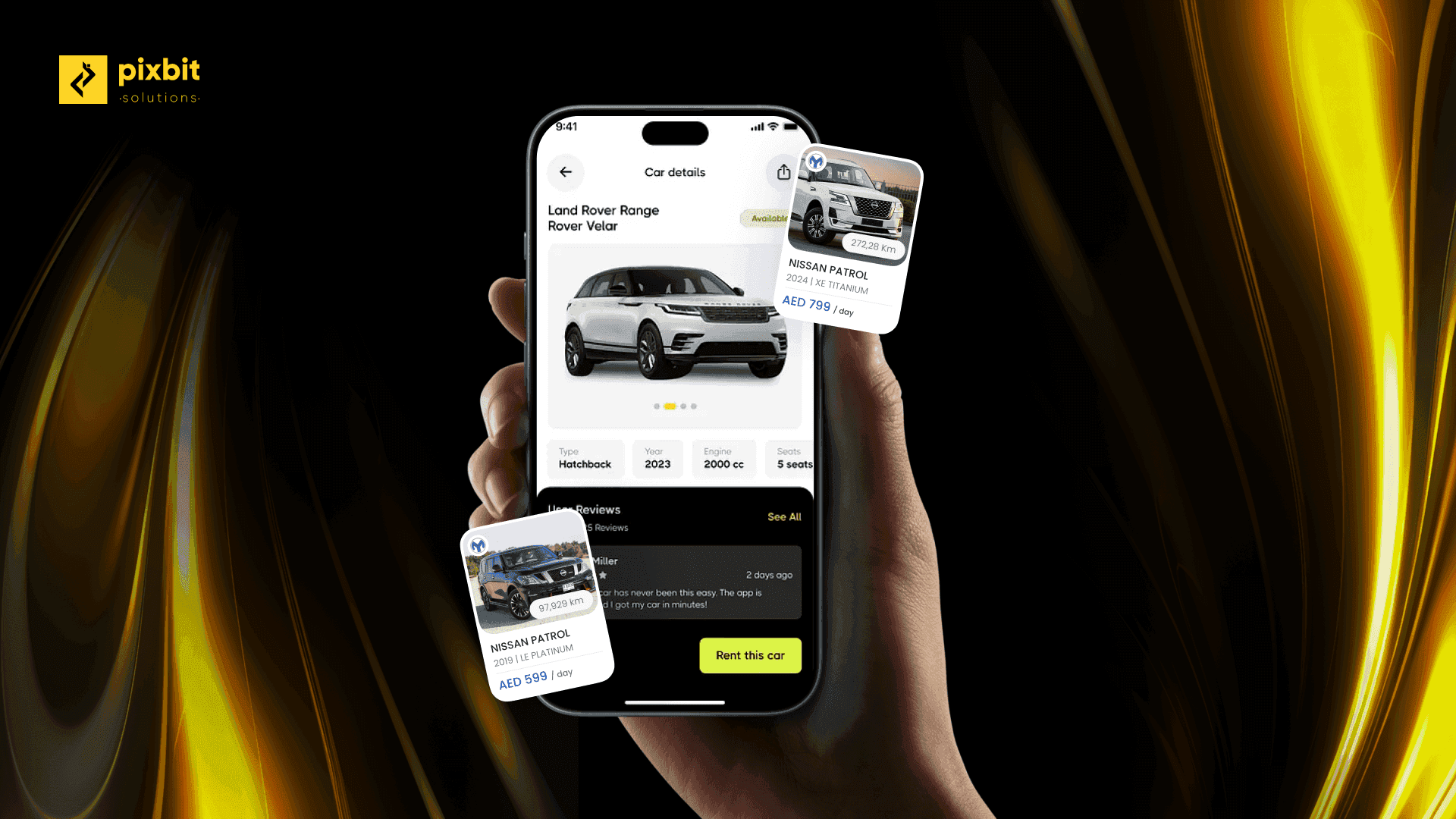
Dubai <u>has always been</u> a city that creates the future rather than waiting for it.
The UAE has continuously embraced technology to make daily life quicker, smarter, and more convenient, from AI-powered government services and smart infrastructure to connected mobility initiatives. This also applies to transportation. Customers can now find, unlock, and pay for a car using just their smartphone with digital platforms that have gradually replaced traditional rental counters, paperwork, and drawn-out verification procedures.
This shift is redefining the entire mobility ecosystem, not just how people rent cars. However, successful car rental app development in UAE requires much more than just an eye-catching user interface and a booking engine for business owners and fleet managers. A networked ecosystem that oversees real-time fleet availability, GPS tracking, identity verification, secure payments, compliance, telematics, and intelligent pricing is the driving force behind every flawless rental experience.
The first step in creating a platform that can compete in one of the fastest-growing transport markets in the world is comprehending the particular market dynamics of the United Arab Emirates, whether you're starting a mobility startup or digitising an already-existing rental company.
UAE Car Rental Market Analysis
The UAE has long been recognised as one of the Middle East's most dynamic transportation markets. Today, it is growing into a technology-driven mobility ecosystem where digital convenience, connected infrastructure, and flexible transportation models are becoming the new standard.
This momentum is reflected in the numbers. The UAE car rental market is projected to generate US$5,243.8 million by 2030, growing at a compound annual growth rate (CAGR) of 13.1% between 2025 and 2030. Although the country accounted for 1.6% of the global car rental market in 2024, it is expected to become the largest revenue-generating market across the Middle East and Africa by the end of the decade.
Renting more cars isn't the reason for this growth. It's taking place as a result of a fundamental shift in how people obtain mobility.
Customers are shifting away from drawn-out rental processes in favour of digital experiences that let them look through available cars, verify their identities, pay, and unlock a car in a matter of minutes. Simultaneously, companies are searching for scalable fleet management solutions that replace manual processes with automated ones.
Tourism Continues to Power Short Term Rental Demand
Few countries benefit from tourism the way the UAE does. From luxury holidays and family vacations to international exhibitions and sporting events, millions of travellers rely on flexible transportation throughout their stay.
According to the Dubai Department of Economy and Tourism (DET), Dubai welcomed 19.59 million international overnight visitors in 2025, representing a 5% increase over the previous year and marking yet another record for the emirate. The city's tourism momentum has been equally impressive over the longer term, while forecasts suggest annual arrivals could approach 20 million visitors by 2026.
This sustained tourism growth has significantly expanded demand for short-term vehicle rentals, particularly airport pickups, family SUVs, premium vehicles, and seven-seater cars preferred by larger travel groups. Rather than relying solely on taxis or public transport, visitors increasingly value the freedom to explore multiple destinations on their own schedule.
Air travel further reinforces this opportunity. Annual passenger traffic at Dubai International Airport reached 95.2 million travellers in 2025, making it one of the busiest international airports in the world. Every arriving passenger represents a potential customer looking for convenient, on-demand mobility immediately after landing.
For businesses into car rental app development in UAE , this entails creating an experience that caters to international travellers from the start. In order to deliver the smooth experience that contemporary travellers require, multilingual interfaces, passport and visa verification, support for international driving permits, airport pickup scheduling, multiple payment gateways, and instant digital onboarding are no longer optional.
Business Travel Creates Stable, Year-Round Demand
While tourism often experiences seasonal peaks, business travel provides a consistent stream of rental demand throughout the year.
As a regional headquarters for multinational corporations, financial institutions, technology companies, and global consultancies, the UAE attracts thousands of executives, entrepreneurs, project teams, and consultants every month. Large-scale exhibitions, conferences, and trade events continue to strengthen this demand, with industry forecasts estimating that Dubai's business events sector will welcome more than 210,000 delegates in the coming years.
Unlike leisure travellers, business users prioritise efficiency above everything else. They expect quick vehicle collection, reliable availability, digital invoices, corporate billing, and flexible rental durations that fit unpredictable schedules.
This creates opportunities beyond traditional daily rentals. Corporate subscriptions, monthly leasing, executive vehicle categories, employee mobility programmes, and centralised fleet dashboards are becoming increasingly valuable services for organised rental operators.
From a software development perspective, supporting business travellers means building features that extend beyond customer bookings. Corporate account management, automated invoicing, approval workflows, expense reporting, and role-based access controls can transform a consumer-focused rental platform into a comprehensive mobility solution for enterprise clients.
Car Sharing is Changing How People Think About Mobility
Perhaps the biggest shift within the UAE's mobility arena isn't the number of vehicles available—it's how people choose to use them.
Instead of viewing a car as something that needs to be owned, more consumers now see transportation as an on-demand service they can access whenever required. This Mobility-as-a-Service (MaaS) approach has accelerated the popularity of app-based car-sharing platforms across the country.
The industry's digital transformation reflects this behavioural shift. Today, around 70% of all car rental transactions are completed through online platforms, while online booking channels generated 63.25% of total market revenue in 2025 and are forecast to grow at a 14.35% CAGR through 2031.
Customers increasingly expect to search nearby vehicles, compare prices, upload documents, make secure payments, and unlock a vehicle without stepping into a rental office. The entire journey from registration to trip completion is expected to happen digitally.
Self-drive rentals continue to dominate this market, accounting for 77.12% of total rental revenue in 2025, while chauffeur-driven services are emerging as one of the fastest-growing segments as customer preferences diversify.
Sophisticated technology powers this experience. Dynamic pricing is enabled by artificial intelligence, IoT devices monitor vehicle health and location, cloud platforms synchronise fleet data in real time, and telematics continuously transmit driving information to fleet operators.
For new businesses entering this space, digital capability is no longer a competitive advantage; it is the minimum requirement. Customers no longer compare your app to just another rental company; they compare it to every digital experience they already have, such as food delivery, ride-hailing, and online banking.
Why the UAE Is Uniquely Attractive for Digital Car Rental Businesses
Many countries have witnessed the rise of app-based car rentals, but few have created an ecosystem where these businesses can scale as successfully as they have in the UAE. The country's combination of digital maturity, progressive government policies, urban development, and a diverse customer base has created the ideal conditions for mobility platforms to flourish.
One of the biggest factors driving this growth is rapid urbanisation. According to World Bank estimates, nearly 90% of the UAE's population is expected to live in urban areas by the end of 2025. As cities continue to expand, so does the demand for flexible transportation. Residents increasingly look for mobility options that fit their lifestyle without the long-term commitment of owning a vehicle.
The country's demographic profile further strengthens this demand. More than 80% of the UAE's population consists of expatriates, many of whom relocate for work assignments, business opportunities, or short-term contracts. For this audience, renting often makes far more financial sense than purchasing a vehicle, particularly when insurance, servicing, maintenance, and depreciation are taken into account.
At the same time, government-led smart mobility initiatives continue to encourage digital transformation across the transportation sector. Projects introduced by Dubai's Roads and Transport Authority (RTA) and mobility initiatives across Abu Dhabi have laid the groundwork for connected transport services, encouraging businesses to adopt digital-first operating models instead of relying on traditional rental processes.
Technology adoption has also reached a point where customers naturally expect transportation to function like every other digital service. Booking accommodation, ordering food, paying bills, accessing government services, and shopping online have all become routine experiences. Renting a car is expected to be no different. Customers want instant verification, cashless payments, digital contracts, and immediate access to a vehicle without unnecessary paperwork.
Looking ahead, the UAE's push towards sustainable mobility is expected to create another wave of innovation. Government initiatives encouraging electric vehicle adoption through expanded charging infrastructure, incentive programmes, and sustainability policies will influence how rental operators manage future fleets. For software platforms, this opens opportunities to support EV-specific capabilities such as battery monitoring, charging station integration, range estimation, and maintenance scheduling.
Taken together, these factors make the UAE more than a rapidly growing rental market. They make it one of the region's most attractive destinations for building intelligent, technology-driven mobility platforms.
Why Apps Like Udrive and ekar Succeeded
The success of Udrive and ekar wasn't built solely on having a mobile application. It came from rethinking the entire rental experience around convenience, flexibility, and digital accessibility.
Traditional rental companies typically required customers to visit a branch, submit physical documents, pay sizeable security deposits, and commit to fixed rental periods. While that model worked for years, it also introduced unnecessary friction into what many customers simply wanted to be a quick and convenient process.
Udrive and ekar challenged that approach by removing as many barriers as possible.
Instead of counters and paperwork, customers could complete registration digitally by verifying their Emirates ID and driving licence directly within the app. Once approved, they could locate a nearby vehicle, unlock it using their smartphone, begin their journey immediately, and pay only for the time they actually used the car.
Their pricing model was equally well suited to the UAE's changing mobility needs. Pay-per-minute rentals made short trips significantly more affordable than traditional daily rentals, while the pricing itself remained transparent. Fuel, insurance, and parking within designated public zones were typically included, giving users greater confidence about what they were paying for without worrying about unexpected costs during the trip.
This model resonated strongly with the UAE's unique customer base. Tourists visiting for only a few days, expatriates on temporary assignments, students, and residents who drove only occasionally all found value in accessing a vehicle without taking on the financial responsibilities of ownership.
Supportive government infrastructure also played an important role. Dubai's Roads and Transport Authority (RTA) introduced policies that encouraged smart mobility services, while designated parking spaces for shared vehicles made the experience even more practical for users. Rather than operating independently, platforms like Udrive and ekar became part of the city's wider vision for connected urban mobility.
Perhaps the biggest lesson these platforms offer isn't about pricing or technology alone. Their success demonstrates that customers don't simply want to rent a car; they want the entire process to feel effortless.
For businesses planning to build a similar platform, this means thinking beyond booking functionality. Every interaction, from identity verification and document validation to payments, vehicle access, trip tracking, toll management, and billing, should work together as one connected digital experience. The more friction removed from the customer journey, the greater the likelihood of user adoption and long-term retention.
This is precisely where software becomes the competitive advantage. While vehicles can be expanded over time, an exceptional digital experience is what differentiates one mobility platform from another in an increasingly competitive market.
UAE Compliance Checklist
Launching a car rental app in the UAE isn't just about developing features that customers love. It also means building a platform that complies with the country's transportation, taxation, insurance, and data privacy regulations.
Unlike many digital businesses, a car rental platform operates at the intersection of mobility, finance, identity verification, and government compliance. Every booking involves validating a driver's eligibility, securing personal information, tracking vehicle usage, calculating tolls, managing insurance coverage, and maintaining accurate financial records. As a result, compliance shouldn't be viewed as a final checklist before launch; it should be considered from the very beginning of product development.
For businesses planning to build an app similar to Udrive or ekar, these regulatory requirements directly influence everything from the onboarding flow and backend architecture to payment processing and fleet management. Before exploring each requirement in detail, it's useful to understand the core compliance areas every UAE car rental platform should address.
- RTA Regulations and Dubai RTA Resolution No. 47 of 2017
Every licensed car rental business operating in Dubai must comply with the regulations established by Dubai's Roads and Transport Authority (RTA). These regulations govern vehicle licensing, operational standards, customer safety, fleet management, and the responsibilities of rental operators.
One of the key regulatory references for rental operators is Dubai RTA Resolution No. 47 of 2017, which outlines operational requirements for vehicle rental activities within the emirate. While customers may never see these regulations directly, they influence how rental companies manage their fleets, maintain records, verify customers, and document every rental transaction.
For software developers, this means compliance begins at the system level. Vehicle records, rental histories, customer information, inspection reports, and operational logs should all be stored in a structured and auditable manner. Every booking should generate a clear digital record that can be retrieved whenever required.
As rental businesses expand across multiple locations, having a centralised system that standardises these operational processes becomes essential for maintaining compliance while scaling efficiently.
- Emirates ID and Driver Licence Verification
One of the first interactions a customer has with a car rental platform is identity verification. Unlike many consumer applications where an email address is sufficient to create an account, car rental platforms must confirm that every customer is legally eligible to drive.
For UAE residents, this typically involves verifying a valid Emirates ID alongside a UAE driving licence. Tourists and non-residents generally need to provide a passport, a valid visa where applicable, and an International Driving Permit (IDP) or another licence accepted under UAE regulations, depending on their country of residence.
Rather than relying on manual document reviews, modern platforms streamline this process through digital onboarding. Customers upload the required documents during registration, allowing the rental operator to validate information before approving the account.
From a software perspective, this onboarding journey should be designed to minimise friction while maintaining compliance. Features such as secure document uploads, OCR-assisted data extraction, selfie verification, and approval workflows can significantly reduce processing time without compromising security.
Identity verification isn't simply the first step of registration—it's the foundation that supports every booking made through the platform.
- UAE PDPL and Customer Data Protection
Every car rental platform collects sensitive customer information, including identification documents, driving licences, payment details, booking history, and location data. Protecting this information is both a legal obligation and a critical factor in building customer trust.
The UAE's Personal Data Protection Law (PDPL) establishes the framework for how organisations collect, process, store, and protect personal data. Businesses are expected to implement appropriate security measures, limit unnecessary data collection, and ensure that customer information is handled responsibly throughout its lifecycle.
For developers, PDPL compliance influences much more than database design. Sensitive information should be encrypted both in transit and at rest, role-based permissions should restrict employee access, and detailed audit logs should record who accesses customer data and when. Data retention policies, consent management, and secure deletion processes should also be incorporated into the platform from the outset rather than added later.
By embedding privacy into the application's architecture, businesses not only meet regulatory expectations but also strengthen customer confidence in the platform.
- VAT-Compliant Billing and Digital Invoicing
Every completed rental generates a financial transaction that must be accurately recorded and invoiced. Whether the customer rents a vehicle for thirty minutes or thirty days, the platform should calculate applicable charges, apply VAT where required, and generate clear digital invoices.
For businesses managing thousands of bookings each month, manual invoicing quickly becomes impractical. Integrating automated billing into the platform ensures consistency while reducing administrative effort.
A well-designed billing engine should calculate rental charges, taxes, additional services, toll fees, late return penalties, and other applicable costs before automatically issuing invoices and payment confirmations. Corporate customers may also require consolidated invoices, recurring billing, and detailed expense reports for accounting purposes.
By automating these processes, rental operators reduce human error while delivering a smoother customer experience.
- Insurance Requirements
Insurance is another critical component of every rental transaction. Depending on the rental agreement, customers may be covered under different levels of protection, including Personal Accident Insurance, Loss Damage Waiver (LDW), or Super Collision Damage Waiver (SCDW).
The application should clearly display available insurance options during booking, allowing customers to understand what is included and select additional coverage where appropriate.
Behind the scenes, the platform should associate each booking with the selected insurance package, ensuring that claims, incident reports, and policy information can be accessed whenever required. This becomes particularly valuable when handling disputes, accident reports, or damage assessments after a rental has ended.
Insurance management is therefore an operational feature that should be integrated directly into the booking workflow.
- Security Deposits and Rental Eligibility
Before a customer can begin a rental, the platform should verify that all eligibility requirements have been met. This goes beyond confirming identity and driving credentials. Rental operators also need to ensure that customers satisfy age requirements, accept the rental agreement, and provide the required security deposit where applicable.
For UAE residents, the onboarding process generally requires:
a. A valid UAE driving licence b. Emirates ID c. Minimum age as defined by the rental company d. Additional verification documents where required
For tourists and non-residents, the platform should support:
a. Passport verification b. Valid visa (where applicable) c. International Driving Permit (IDP) or another licence recognised under UAE regulations d. Minimum age verification
Security deposits are commonly used to cover potential damages, traffic fines, Salik charges, late returns, or other rental-related costs. While the amount varies by vehicle type and rental company, luxury vehicles and long-term rentals generally require higher deposits. To improve efficiency, the platform should automate deposit authorisation, track deductions, notify customers of any adjustments, and process refunds once all outstanding charges are cleared. This ensures greater transparency while reducing manual effort and billing disputes.
- Salik Integration
Every rental vehicle in Dubai is equipped with a Salik tag, allowing toll charges to be recorded automatically whenever the vehicle passes through a Salik gate. Unlike private vehicle owners, renters don't need to manage a Salik account, as the rental company handles all toll transactions. The platform automatically tracks each rental session, including the assigned vehicle, rental duration, toll crossings, and applicable charges, before adding them to the customer's final invoice. By linking every Salik transaction to the customer using the vehicle at that time, the system ensures accurate billing while eliminating manual reconciliation.
- Traffic Fine Management
Traffic fines are often issued after a rental has ended, making manual tracking difficult. To address this, the platform should maintain a complete history of every rental session, allowing operators to identify the customer responsible for the vehicle when the offence occurred. When integrated with government traffic systems, the app can automatically associate fines with the correct rental, notify customers, and update billing records, simplifying fleet operations while ensuring penalties are assigned accurately.
Feature Priority Framework
One of the most common mistakes businesses make in car rental app development in UAE is trying to launch with every possible feature. While it may seem appealing to replicate platforms like Udrive or ekar from day one, doing so often leads to longer development cycles, higher costs, and delayed market entry.
A more practical approach is to build the platform in phases. Start with the features required to launch a reliable and compliant MVP (Minimum Viable Product), validate customer demand, gather real-world feedback, and then expand the platform with advanced capabilities as the business grows.
This phased development strategy reduces risk while ensuring every new feature is introduced with a clear business objective.
- MVP Features
The MVP should focus on delivering a complete end-to-end rental journey. Every feature included at this stage should support a customer's ability to register, book, drive, and pay for a vehicle without unnecessary complexity.
- User Registration and Verification
Registration is far more than creating an account. The onboarding process should guide users through document submission, identity verification, driving licence validation, and profile creation before allowing them to make a booking.
An intuitive onboarding experience not only improves customer confidence but also reduces drop-offs during registration.
- Vehicle Search and Availability
Customers should be able to browse available vehicles based on location, category, pricing, and availability.
Interactive maps, search filters, and real-time fleet availability help users quickly find a suitable vehicle while preventing double bookings.
Displaying accurate availability is equally important for fleet operators, as it improves vehicle utilisation and operational planning.
- Booking and Reservation Management
Once a customer selects a vehicle, the booking process should be straightforward.
The application should allow users to:
a. Reserve a vehicle instantly b. Select the preferred rental duration c. View pricing before confirmation d. Review rental terms e. Receive instant booking confirmation
Behind the scenes, the system should temporarily reserve the vehicle to prevent duplicate reservations while updating fleet availability in real time.
- Secure Payments
A smooth payment experience is fundamental to customer satisfaction. The platform should support secure online payments through trusted payment gateways while handling deposits, refunds, VAT calculations, promotional discounts, and digital receipts automatically.
For customers, payment should feel effortless. For operators, it should provide complete financial transparency.
- GPS Tracking and Vehicle Location
Location services power almost every aspect of a modern car rental application.
GPS integration enables customers to:
a. Locate nearby vehicles b. Navigate to pickup locations c. Track ongoing rentals d. Find designated return zones
For fleet operators, GPS provides real-time visibility into vehicle locations, utilisation, and operational status, making it one of the most valuable features within the entire platform.
- Growth Features
Once the platform has established a stable customer base and operational workflow, the focus shifts from acquiring users to increasing retention and lifetime value.
Growth-stage features encourage customers to return more frequently while creating additional revenue opportunities.
- Subscription Plans
Not every customer needs a vehicle for just a few hours.
Many residents, professionals, and businesses prefer weekly or monthly subscriptions that provide greater flexibility than vehicle ownership without the commitment of a long-term lease.
Subscription management enables customers to upgrade, renew, or modify their plans while providing operators with predictable recurring revenue.
- Loyalty and Rewards Programmes
Rewarding repeat customers helps strengthen retention in an increasingly competitive market.
A loyalty programme can encourage continued engagement by offering:
a. Reward points for completed rentals b. Discount vouchers c. Free rental hours d. Exclusive promotional offers e. Tier-based membership benefits
Over time, these incentives help reduce customer acquisition costs by increasing repeat bookings.
- Referral Programmes
Word-of-mouth remains one of the most effective customer acquisition channels.
Referral programmes encourage existing users to invite friends or colleagues in exchange for rental credits, promotional discounts, or bonus loyalty points.
When implemented effectively, referrals create sustainable customer growth while reducing dependence on paid advertising.
- Enterprise Features
As fleet sizes increase, manual processes become increasingly difficult to manage.
Enterprise-level features focus less on customer interaction and more on operational efficiency, automation, and data-driven decision-making.
- AI-Powered Dynamic Pricing
Demand for rental vehicles changes constantly based on seasonality, tourism, location, vehicle availability, and local events.
Rather than relying on fixed pricing, AI-powered pricing engines analyse demand patterns and automatically adjust rental rates to maximise fleet utilisation and revenue.
This allows operators to remain competitive while responding quickly to changing market conditions.
- Predictive Maintenance
Unexpected vehicle breakdowns lead to cancelled bookings, unhappy customers, and unnecessary maintenance expenses.
Predictive maintenance uses telematics data, vehicle diagnostics, mileage, and servicing history to identify potential issues before they become major failures.
Instead of reacting to breakdowns, operators can schedule maintenance proactively, improving fleet reliability and reducing downtime.
- Telematics Integration
Modern connected vehicles continuously generate valuable operational data.
Telematics systems monitor:
a. Vehicle location b. Fuel consumption c. Driving behaviour d. Battery health (for EVs) e. Speed f. Engine diagnostics g. Idle time
This information helps operators optimise fleet performance while improving customer safety and reducing operational costs.
- Fleet Optimisation
As the fleet grows, maximising vehicle utilisation becomes just as important as expanding inventory.
Fleet optimisation tools analyse booking trends, demand forecasts, maintenance schedules, and vehicle availability to recommend how vehicles should be distributed across different locations. This data-driven approach improves utilisation rates while reducing idle vehicles and operational inefficiencies.
Estimated Development Cost for an App Like Udrive or ekar in the UAE
One of the first questions entrepreneurs ask before starting a mobility project is, "How much will it cost for car rental app development in UAE?"
The answer depends on far more than the number of screens in the application. Unlike a standard booking app, a UAE car rental platform must combine customer-facing mobile applications with backend fleet management, secure payment processing, real-time GPS tracking, identity verification, government compliance, and multiple third-party integrations.
The scope of the platform, the level of automation, the chosen technology stack, and future scalability all influence the overall investment.
For businesses looking to launch an MVP capable of supporting real-world rental operations, a realistic development budget typically falls between USD 70,000 to USD 110,000. This estimate covers the development of a production-ready platform with the essential functionality required to enter the market.
| Development Phase | Estimated Cost | Key Activities & Deliverables |
|---|---|---|
| Market Research & Planning | $5,000 – $8,000 | Business analysis, competitor research, feature prioritisation, technical planning, project roadmap |
| UI/UX Design | $5,000 – $10,000 | User journey mapping, wireframes, interface design, interactive prototypes |
| App Development (Frontend & Backend) | $50,000 – $80,000 | iOS and Android app development, backend platform, admin dashboard, fleet management, booking engine, authentication, APIs |
| Third-Party Integrations | $5,000 – $10,000 | Payment gateway, maps, GPS services, notifications, analytics, identity verification and other external services |
| Testing & Quality Assurance | $5,000 – $8,000 | Functional testing, security testing, performance optimisation, bug fixing and user acceptance testing |
| Deployment & Launch | $3,000 – $5,000 | Production deployment, cloud configuration, app store submission, launch support |
| Maintenance & Updates (Annual) | Approximately 15–20% of the initial development cost | Feature enhancements, bug fixes, operating system updates, security improvements and infrastructure monitoring |
It's important to remember that this estimate represents an MVP designed to launch successfully in the market. Features such as AI-powered pricing, predictive maintenance, advanced telematics, subscription management, and enterprise analytics would typically be introduced during later development phases.
What Has the Biggest Impact on Development Cost?
No two car rental platforms are identical. Even businesses operating in the same market may have very different technical requirements depending on their fleet size, customer segments, and long-term business goals.
What Influences Car Rental App Development Cost?
Several factors determine the overall cost of developing a car rental app.
-
Platform Strategy: Building separate native apps for iOS and Android costs more than using cross-platform frameworks like Flutter, making the latter a popular choice for startups looking to launch faster and more cost-effectively.
-
Feature Complexity: An MVP with booking, payments, GPS, and vehicle search requires a much smaller investment than a platform with AI pricing, subscriptions, telematics, predictive maintenance, and enterprise analytics.
-
UI/UX Design: A well-designed interface improves customer experience and retention. While custom UI/UX increases upfront costs, it often reduces support requests and enhances long-term user engagement.
-
Third-Party Integrations: Integrating payment gateways, maps, notifications, identity verification, and fleet management tools adds to both development time and budget.
-
Development Team: Costs also vary depending on the location and expertise of your development partner, with many businesses outsourcing to experienced software companies for better value.
Practical Ways to Optimise Development Costs
Reducing costs doesn't mean compromising on quality. Businesses can optimise their budget by launching with an MVP, using cross-platform technologies, leveraging reliable third-party APIs, building a scalable architecture, and automating testing and deployment. This phased approach allows businesses to validate their idea before investing in advanced features.
Hidden Costs to Consider
Development expenses continue after launch. Businesses should also budget for cloud hosting, app store fees, third-party API subscriptions, cybersecurity, marketing, customer support, and regular updates. Together, these ongoing costs typically account for 15–20% of the annual technology budget.
Development Cost Is an Investment
While choosing the lowest-cost option may seem appealing, long-term success depends on building a scalable platform. A robust architecture enables businesses to introduce features like subscriptions, AI-powered pricing, EV fleet management, and advanced analytics without rebuilding the application as the business grows, delivering greater value over time.
Complete System Architecture
Every successful car rental application is powered by much more than a mobile app. While customers interact with a clean, intuitive interface, an entire ecosystem of interconnected services works behind the scenes to manage bookings, vehicles, payments, compliance, and fleet operations in real time.
As the business grows from a few dozen vehicles to hundreds or even thousands across multiple cities, this underlying architecture becomes critical. A scalable system ensures that every booking, payment, GPS update, and vehicle status change is processed accurately without slowing down the user experience.
Below is a high-level overview of the core components that form the foundation of a modern UAE car rental platform.
- Mobile Applications
The mobile application is the primary touchpoint between customers and the rental business. It should provide an efficient experience from registration to trip completion, allowing users to complete every stage of the rental journey without visiting a physical branch.
Core capabilities include:
a. User registration and profile management b. Emirates ID and driving licence document upload c. Vehicle discovery using maps and search filters d. Booking and reservation management e. Secure digital payments f. Digital rental agreements g. GPS navigation to nearby vehicles h. Trip history and invoices i. Push notifications for booking updates, reminders, and promotions
While customers use the mobile application, rental operators require a separate administrative interface to manage vehicles, monitor bookings, approve users, handle maintenance requests, and oversee daily fleet operations.
- Backend Platform
If the mobile app is the face of the platform, the backend is its operational brain.
Every action performed by the customer flows through the backend before being processed and recorded. Whether someone books a vehicle, uploads a driving licence, extends a rental, or makes a payment, the backend coordinates these activities while ensuring that information remains synchronised across the system.
The backend is responsible for:
a. User authentication and account management b. Booking management c. Fleet availability d. Pricing calculation e. Vehicle assignment f. Payment processing g. Rental agreements h. Compliance records i. Administrative controls j. Reporting and analytics
A modular backend architecture also makes future expansion much easier. As the business grows, new services such as subscriptions, AI pricing, EV management, or corporate accounts can be introduced without disrupting existing functionality.
- Database Management
Every booking, customer profile, vehicle record, payment, invoice, inspection report, maintenance log, and rental agreement needs to be stored securely and retrieved instantly when required.
This responsibility belongs to the database layer.
Rather than storing isolated pieces of information, the database creates relationships between customers, vehicles, bookings, payments, and operational records. This enables the platform to answer questions such as:
a. Which customer rented this vehicle yesterday? b. When was the last maintenance completed? c. Has the customer's security deposit been refunded? d. Which vehicles are currently available near Dubai Marina? e. Which rentals generated the highest revenue this month?
As the fleet grows, database performance becomes increasingly important for maintaining fast search results and real-time availability.
- API Integrations
No modern mobility platform operates independently.
Instead, it communicates continuously with external services through Application Programming Interfaces (APIs), allowing different systems to exchange information securely and automatically.
Depending on the business model, API integrations may include:
a. Payment gateways b. Identity verification services c. Mapping and navigation providers d. SMS and email notification services e. Cloud storage platforms f. Analytics tools g. Fleet telematics systems h. CRM platforms i. Accounting software
Well-designed APIs reduce manual work while ensuring that data flows smoothly across every operational process.
- Payment Gateway Integration
Payments are central to the customer experience.
The platform should support secure online transactions while handling deposits, refunds, VAT calculations, promotional discounts, subscription payments, and recurring billing where required.
An integrated payment system should also generate digital invoices automatically, reducing administrative effort while maintaining financial accuracy.
For enterprise customers, support for corporate billing, consolidated invoices, and scheduled payments can further enhance the platform's capabilities.
- Maps and GPS Services
Location technology is at the heart of every car rental platform.
Maps and GPS services enable customers to:
- Locate nearby vehicles
- Receive navigation assistance
- Identify approved parking zones
- Return vehicles to designated locations
For operators, GPS provides real-time fleet visibility, helping them monitor vehicle usage, optimise utilisation, recover misplaced vehicles, and respond quickly to operational issues.
As fleets expand across multiple cities, accurate location tracking becomes essential for maintaining service quality and operational efficiency.
- Notification Services
Communication plays a vital role throughout the customer journey. Rather than relying on manual updates, automated notification services keep users informed at every stage of the rental process.
Typical notifications include:
a. Registration approval b. Booking confirmation c. Payment confirmation d. Vehicle pickup reminders e. Rental extension alerts f. Return reminders g. Security deposit updates h. Promotional offers i. Maintenance-related announcements
Delivering timely notifications improves transparency while reducing missed bookings and customer support enquiries.
- Analytics and Business Intelligence
Every rental generates valuable operational data.
When analysed effectively, this information helps businesses make smarter decisions about pricing, fleet expansion, marketing, maintenance, and customer engagement.
An analytics layer typically monitors:
- Vehicle utilisation rates
- Fleet occupancy
- Revenue trends
- Booking patterns
- Customer acquisition channels
- Peak rental periods
- Cancellation rates
- Average trip duration
- Customer retention
- Operational costs
Rather than relying on assumptions, operators can use these insights to improve fleet performance, identify growth opportunities, and make evidence-based business decisions.
Development Timeline Roadmap
One of the biggest misconceptions about building a car rental application is that development begins with writing code. In reality, successful mobility platforms spend a significant amount of time on planning, user experience, and technical architecture before development even starts.
A phased development roadmap helps teams reduce project risks, validate ideas early, and build a platform that's ready to scale. While timelines vary depending on project scope, integrations, and feature complexity, an MVP similar to Udrive or ekar can typically be developed within 8 to 12 months.
Here's what that journey usually looks like.
- Discovery and Product Planning
Every successful project starts with a clear understanding of the business.
During the discovery phase, stakeholders work together to define business goals, identify target users, analyse competitors, and prioritise features for the MVP. This stage also includes technical planning, architecture discussions, compliance requirements, and integration planning.
Typical activities include:
- Market and competitor analysis
- Product requirement workshops
- Feature prioritisation
- User journey mapping
- Technology stack selection
- Technical architecture planning
- Project roadmap creation
A well-executed discovery phase significantly reduces costly changes later in the project.
- UX and UI Design
With the product strategy in place, attention shifts to creating the customer experience.
Designers begin translating business requirements into user-friendly interfaces, ensuring every interaction feels intuitive from registration through trip completion.
This phase generally includes:
- Wireframing
- Interactive prototypes
- User interface design
- Design system creation
- Customer journey optimisation
- Usability reviews
Rather than focusing only on visual appeal, the objective is to minimise friction throughout the rental journey.
- MVP Development
This is where the platform begins taking shape.
Frontend and backend teams work simultaneously to develop customer-facing applications, administrative dashboards, APIs, and core operational systems.
Development typically includes:
- User authentication
- Customer onboarding
- Document verification
- Vehicle search
- Booking engine
- Fleet management
- GPS integration
- Payment gateway integration
- Notification services
- Admin dashboard
- Reporting modules
By the end of this phase, the platform should support the complete rental journey from registration to trip completion.
- Quality Assurance and User Acceptance Testing
Before launch, every workflow should be tested under real-world conditions.
Quality assurance extends beyond identifying software bugs. Teams also validate business logic, booking workflows, payment processing, compliance requirements, and overall system performance.
Testing activities commonly include:
- Functional testing
- Security testing
- Performance testing
- Device compatibility testing
- Payment validation
- GPS accuracy testing
- User acceptance testing (UAT)
Resolving issues before launch helps ensure a stable customer experience from day one.
- Deployment and Market Launch
With testing complete, the platform is prepared for production.
During deployment, the development team configures cloud infrastructure, publishes the mobile applications, migrates production data, and performs final system checks before the public launch.
Launch activities usually include:
- Cloud deployment
- Production environment configuration
- App Store submission
- Google Play submission
- Final security verification
- Performance monitoring
- Initial customer onboarding support
Although the application is now live, development doesn't stop here.
- Continuous Improvement and Scaling
The first few months after launch often generate the most valuable product insights.
Customer behaviour, booking trends, operational challenges, and user feedback help identify which features should be prioritised next.
Future development may include:
- Subscription plans
- Loyalty programmes
- Referral systems
- AI-powered pricing
- Predictive maintenance
- Advanced telematics
- Fleet optimisation
- Corporate account management
- EV fleet support
- Business intelligence dashboards
This continuous improvement cycle allows the platform to evolve alongside customer expectations and business growth.
Common Failure Reasons
The UAE presents enormous opportunities for digital car rental businesses, but not every platform succeeds. In many cases, failure isn't caused by poor technology alone. It results from overlooking operational realities, customer expectations, or regulatory requirements during the planning stage.
Understanding these common pitfalls before development begins can save businesses significant time, money, and operational challenges.
- Poor Fleet Utilisation
Adding more vehicles doesn't automatically generate more revenue.
One of the biggest mistakes new rental businesses make is expanding the fleet before understanding customer demand. Vehicles that remain idle for long periods continue to incur insurance, maintenance, depreciation, and parking costs without generating income.
A well-designed platform should monitor utilisation rates, identify underperforming vehicles, and provide insights that help operators optimise fleet distribution across different locations.
- Compliance Failures
Ignoring regulatory requirements can create far greater problems than software bugs.
Incomplete customer verification, poor record management, non-compliant invoicing, or weak data protection practices can lead to operational disruptions and damage customer trust.
Compliance should therefore be incorporated into the product architecture from the very beginning rather than treated as a post-launch requirement.
- Poor Pricing Strategy
Competitive pricing attracts customers, but sustainable pricing keeps the business profitable.
Setting prices too low may increase bookings while reducing margins. Charging too much can drive customers toward competitors.
Successful rental platforms continuously evaluate demand, vehicle availability, seasonality, and customer behaviour to maintain pricing that balances utilisation with profitability.
As businesses grow, AI-assisted pricing models become increasingly valuable for responding to changing market conditions automatically.
- Weak Customer Onboarding
Customers expect to complete registration quickly.
Lengthy approval processes, confusing document uploads, excessive manual verification, or complicated booking flows often lead users to abandon the application before completing their first rental.
Reducing friction during onboarding is one of the most effective ways to improve customer acquisition and increase completed bookings.
- Inaccurate Vehicle Availability
Nothing damages customer confidence faster than booking a vehicle that isn't actually available.
Without real-time fleet synchronisation, customers may encounter duplicate bookings, unavailable vehicles, or last-minute cancellations.
Accurate inventory management requires continuous communication between the booking engine, fleet management system, and vehicle tracking services, ensuring that availability is updated instantly whenever a booking is created, modified, or completed.
Conclusion
The UAE's car rental industry is no longer defined by physical branches and daily rental agreements. It is growing into a connected mobility ecosystem where customers expect to find, book, unlock, and return vehicles with the same ease as ordering food or booking a flight.
With strong market growth, record-breaking tourism, increasing business travel, government-backed smart mobility initiatives, and widespread digital adoption, the UAE offers one of the most promising environments for launching app-based car rental and car-sharing platforms. But market opportunity alone isn't enough.
Building a successful platform requires much more than developing a mobile application. It demands a deep understanding of local regulations, identity verification, secure payment processing, fleet management, GPS tracking, Salik integration, customer experience, and a scalable technology architecture that can grow alongside the business.
The most successful platforms aren't necessarily the ones with the longest feature lists. They're the ones that solve real customer problems, automate complex operational workflows, and continue evolving as user expectations change. Starting with a focused MVP, validating the business model, and expanding strategically is often a far more sustainable approach than trying to build everything at once.
Whether you're launching a new mobility startup, modernising an existing car rental business, or exploring a car-sharing model similar to Udrive or ekar, investing in the right technology foundation from the outset can significantly influence your long-term success.
Pixbit Solutions aims to help businesses transform ambitious mobility ideas into scalable digital products. From product strategy and UI/UX design to custom car rental app development in UAE, fleet management systems, third-party integrations, and ongoing product evolution, our team builds solutions tailored to the operational realities of the UAE and the wider GCC market.
The future of mobility is becoming increasingly connected, data-driven, and customer-centric. Businesses that invest in flexible, scalable, and intelligent digital platforms today will be better positioned to meet tomorrow's customer expectations and lead the next generation of mobility services across the region.

Nabeel Al Nassir
Digital Marketer
Share on
Have an idea that needs to go mobile? Launch it with us!
Have an idea that needs to go mobile? Launch it with us!
Let's Talk
You May Also Like
Explore insightful articles and tips from our experts on the latest trends in web development and marketing.




Have an idea ?
Let's make it happen
Tell us your business aspirations, and let's craft a custom solution that drives business growth, ensuring satisfaction and exceeding your goals with precision.
Let's Talk