
Carbon Accounting Software for UAE Free Zones: A White-Label Build Guide
Nabeel Al Nassir
June 24, 2026
4 Min read
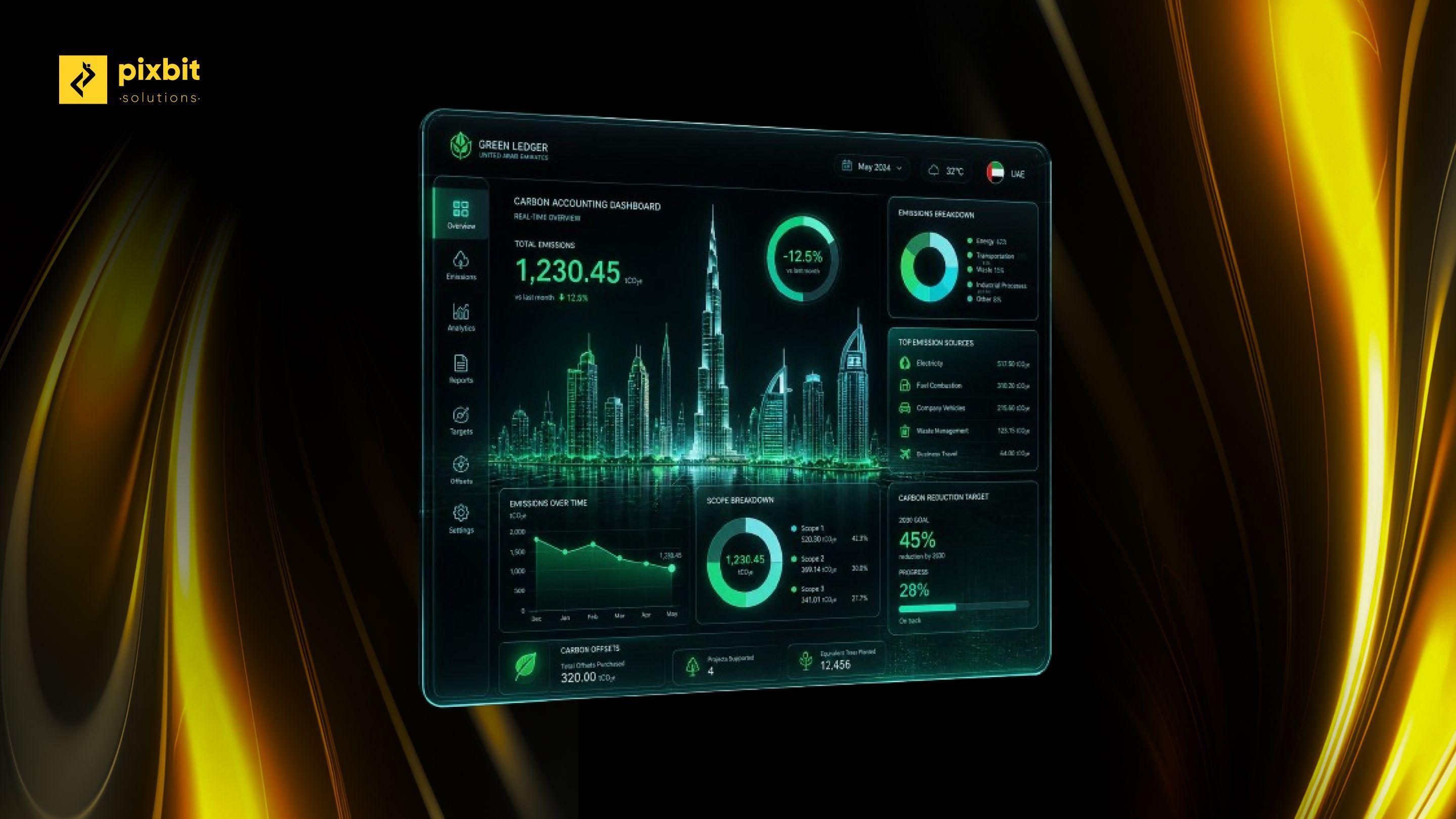
The UAE's sustainability regulations are creating a new challenge for free zone authorities. Compliance is no longer limited to the authority itself. Thousands of tenant companies operating inside free zones increasingly need carbon measurement, emissions reporting, ESG disclosure, and sustainability tracking capabilities to satisfy customer requirements, investor expectations, and emerging regulatory obligations.
For authorities managing large business ecosystems, the question is no longer whether tenants need carbon accounting. The question is whether the free zone becomes the platform that enables it.
A white-label carbon accounting software UAE free zone solution allows authorities such as JAFZA, DMCC, DAFZA, RAKEZ, KEZAD, and other economic zones to provide sustainability infrastructure directly to their tenant community. Instead of every company purchasing separate software, the authority can offer a centralized carbon accounting platform branded as its own service.
This creates a rare B2B2B opportunity. The authority strengthens tenant retention, supports ESG objectives, creates a new value-added service, and potentially introduces recurring revenue streams, while tenants gain access to sustainability reporting tools without the complexity of sourcing enterprise software independently.
This guide explains what a white-label carbon accounting platform for UAE free zones should include, how the architecture works, and what authorities should consider before launching.
Why UAE Free Zones Are Becoming Sustainability Platforms
Free zones have evolved significantly beyond licensing and office space.
Today, leading economic zones provide digital services, trade support, customs integration, business intelligence, financing programs, startup ecosystems, and innovation initiatives. Sustainability services represent the next logical evolution.
Many multinational companies operating inside UAE free zones already face emissions disclosure requirements from customers, parent companies, investors, and international supply chains.
A European manufacturer operating in JAFZA may need Scope 1, Scope 2, and Scope 3 emissions reporting to comply with CSRD requirements. A logistics company in DAFZA may be required to provide carbon footprint information during procurement processes. A technology company in DMCC may need sustainability reporting to satisfy investor due diligence.
The challenge is that most SMEs inside free zones lack dedicated sustainability teams.
A free zone authority that provides carbon accounting infrastructure directly to tenants removes a significant adoption barrier while simultaneously positioning itself as a sustainability leader.
Why Generic Carbon Accounting Platforms Fall Short
Most global carbon accounting platforms are designed for individual enterprises.
Their onboarding assumes a single organization purchasing software directly, configuring emissions sources independently, and managing reporting internally.
A free zone environment introduces an entirely different operational model.
The authority needs multi-tenant architecture supporting hundreds or thousands of separate companies simultaneously. Each tenant requires isolated data environments, independent reporting, separate user permissions, and distinct emissions calculations.
The authority also requires ecosystem-wide visibility without compromising tenant confidentiality.
Generic carbon accounting platforms rarely support this structure natively.
The result is often a fragmented environment where each tenant purchases different software, uses different methodologies, and produces inconsistent reporting outputs.
A white-label platform solves this by creating a common sustainability infrastructure layer across the entire free zone ecosystem.
The White-Label Opportunity Most Free Zones Haven't Considered
Traditional free zone services generate revenue through licenses, permits, visas, facilities, and support services.
Carbon accounting introduces a new category: sustainability-as-a-service.
Instead of charging per company license manually, authorities can bundle sustainability services into premium business packages or offer subscription-based access across their tenant base.
The model resembles how free zones previously adopted CRM platforms, ERP services, and digital business portals.
The difference is that sustainability reporting is rapidly becoming a business requirement rather than an optional productivity tool.
This creates long-term recurring demand.
As emissions reporting obligations expand globally, tenant companies increasingly require measurement, tracking, benchmarking, audit support, and disclosure capabilities.
The authority becomes the provider of that infrastructure.
The 6 Core Layers of a Free Zone Carbon Accounting Platform
Layer 1: Multi-Tenant Organization Management
The platform must support thousands of independent companies operating within a single environment.
Each tenant requires separate users, emissions records, reports, dashboards, and sustainability metrics.
The authority manages the ecosystem, while each company manages only its own data.
This architecture forms the foundation of any white-label deployment.
Layer 2: Carbon Data Collection Engine
Carbon accounting begins with data collection.
Tenant companies need structured workflows for recording fuel consumption, electricity usage, water consumption, waste generation, transportation activity, refrigerants, business travel, and procurement data.
The platform should standardize data collection across all participating organizations.
Standardization improves reporting quality while reducing onboarding complexity.
Layer 3: Emissions Calculation Engine
Once operational data is captured, emissions calculations convert activity into carbon dioxide equivalent (CO₂e).
The engine should support internationally recognized methodologies including:
- GHG Protocol
- ISO 14064
- Science Based Targets framework
- IFRS Sustainability standards
Emission factors should remain centrally managed so all tenant companies use consistent calculation methodologies.
This prevents reporting discrepancies across the ecosystem.
Layer 4: Reporting and Disclosure
Most organizations do not need raw emissions calculations.
They need reports.
The platform should automatically generate:
- Corporate carbon footprint reports
- Scope 1 emissions reports
- Scope 2 emissions reports
- Scope 3 summaries
- ESG disclosure reports
- Sustainability performance dashboards
- Investor reporting packages
- Procurement reporting documents
Automation dramatically reduces reporting effort for SMEs.
Layer 5: Authority-Level Ecosystem Analytics
This is where white-label platforms become uniquely valuable.
The authority gains anonymized ecosystem-level visibility into sustainability performance.
Examples include:
- Total emissions across the free zone
- Emissions by sector
- Renewable energy adoption
- Waste reduction performance
- Sustainability participation rates
- Tenant benchmarking metrics
This data helps authorities support broader sustainability initiatives without exposing confidential tenant information.
Layer 6: Benchmarking and Improvement Programs
Once emissions data exists, the next step is improvement.
The platform should identify reduction opportunities and compare tenant performance against industry benchmarks.
Authorities can then launch sustainability programs targeted at specific sectors, creating additional value for tenants while advancing ecosystem-wide climate objectives.
What Free Zone Authorities Need Beyond Carbon Tracking
Most discussions focus exclusively on emissions calculations.
In reality, free zone authorities require much more.
The platform should include sustainability onboarding workflows integrated directly into business registration processes.
New companies entering the free zone should automatically receive sustainability accounts alongside licensing credentials.
Training modules should educate tenants on emissions reporting requirements.
Knowledge gaps remain one of the largest barriers to adoption.
Certification management capabilities should support standards such as ISO 14001, ISO 50001, LEED, and other sustainability frameworks commonly pursued by tenants.
Document management systems should centralize evidence, audit records, utility bills, supplier declarations, and compliance documentation.
Without these operational features, carbon accounting remains disconnected from actual sustainability management.
The 5-Step Build Process
Sustainability Strategy Definition
Before development begins, authorities must define business objectives.
The platform may focus on regulatory support, tenant services, recurring revenue generation, ESG leadership, or a combination of all four.
These goals influence architecture decisions.
Multi-Tenant Architecture Design
The platform structure determines future scalability.
Supporting 100 companies and supporting 10,000 companies are fundamentally different technical challenges.
Scalability planning should occur before development starts.
Emissions Engine Development
Calculation logic forms the platform's core.
Emission factors, reporting methodologies, calculation frameworks, and disclosure standards must be configured accurately from day one.
White-Label Tenant Portal Build
Tenant-facing experiences require custom branding, onboarding workflows, dashboards, reporting tools, and administrative controls.
The authority's brand should remain visible throughout the platform experience.
Analytics and Ecosystem Reporting
The final phase focuses on ecosystem intelligence.
Authorities require visibility into sustainability performance trends without compromising tenant privacy.
This reporting layer transforms the platform from a compliance tool into a strategic management system.
What Does a White-Label Carbon Accounting Platform Cost?
Costs vary significantly based on tenant volume, reporting complexity, integration requirements, and sustainability objectives.
A basic multi-tenant platform supporting carbon measurement, emissions calculations, reporting, and white-label branding typically starts in the mid five-figure USD range.
Enterprise deployments supporting thousands of tenants, advanced analytics, benchmarking, ESG frameworks, and ecosystem-wide reporting scale significantly beyond that.
The largest cost drivers are:
- Multi-tenant architecture
- Emissions calculation complexity
- Reporting automation
- Third-party integrations
- Analytics requirements
- Authority-level dashboards
Most free zone authorities evaluate the platform against long-term tenant retention, value-added service revenue, and sustainability positioning rather than software cost alone.
5 Mistakes Free Zones Make When Evaluating Carbon Accounting Platforms
Mistake 1: Buying Enterprise Software for Every Tenant
Enterprise carbon accounting platforms are often designed for large corporations.
Deploying them individually across hundreds of SMEs creates adoption and cost challenges.
Mistake 2: Ignoring Multi-Tenant Requirements
Many solutions were never designed for ecosystem-wide deployment.
Retrofitting multi-tenancy later is expensive and technically complex.
Mistake 3: Focusing Only on Reporting
Reporting is the output, not the system.
Data collection, governance, onboarding, benchmarking, and improvement programs matter equally.
Mistake 4: Overlooking White-Label Branding
If tenants perceive the platform as a third-party tool, strategic value decreases.
The authority should remain the primary service provider.
Mistake 5: Treating Sustainability as a One-Time Initiative
Carbon accounting is not a project.
It becomes an ongoing operational service supporting tenant growth, compliance, and reporting requirements over time.
Why This Is a High-Value Opportunity for UAE Free Zones
Most sustainability software vendors target individual companies.
Very few target ecosystem operators.
That creates a significant market opportunity.
A free zone authority already has the distribution channel, customer base, trust, and operational relationship required to drive adoption.
Instead of selling software one company at a time, the authority can provide sustainability infrastructure to an entire business community simultaneously.
Few digital services offer comparable leverage.
Getting Started
Before selecting technology, free zone authorities should determine how sustainability services fit into their broader tenant experience strategy.
The most successful platforms will not simply measure emissions. They will help thousands of businesses understand, improve, and report sustainability performance through a single ecosystem-wide solution.
For authorities evaluating a white-label carbon accounting platform, the first step is scoping the tenant ecosystem, reporting requirements, and long-term sustainability objectives before any development begins.
How a White-Label Carbon Accounting Platform Works Inside a UAE Free Zone
A white-label carbon accounting platform operates differently from a conventional sustainability application.
Instead of serving a single company, the platform functions as a sustainability infrastructure layer for an entire business ecosystem. The free zone authority owns and manages the platform, while tenant companies access branded portals under the authority's umbrella.
When a new company registers within the free zone, sustainability onboarding can be integrated directly into the business setup process. Alongside trade license issuance, office allocation, and portal credentials, the tenant receives access to its sustainability workspace.
From day one, the company can begin tracking emissions, recording environmental data, generating reports, and benchmarking performance against industry peers.
The authority remains the platform provider, while each tenant maintains control over its own operational data.
This approach eliminates the fragmented environment created when hundreds of companies independently adopt different sustainability tools, methodologies, and reporting frameworks.
Multi-Tenant Architecture: The Foundation Layer
The most important technical requirement is multi-tenancy.
Every tenant company must operate inside a completely isolated environment while sharing the same platform infrastructure.
A logistics company should never see the emissions data of a manufacturing company. A financial services firm should not have access to another tenant's reporting records.
At the same time, the authority requires ecosystem-wide visibility.
The solution is a multi-layer architecture where:
- Tenant-level data remains private
- Authority-level reporting remains aggregated
- Administrative access follows strict permission controls
- Benchmarking uses anonymized datasets
This structure allows free zones to support thousands of organizations without compromising confidentiality.
Industry-Specific Carbon Accounting Workflows
Not every tenant generates emissions the same way.
A manufacturing business operating in JAFZA tracks energy consumption, machinery fuel usage, logistics activity, and production-related emissions.
A technology company in Dubai Internet City may primarily measure electricity consumption, cloud infrastructure impact, business travel, and office operations.
A logistics company inside KEZAD or Dubai South may focus heavily on fleet emissions, warehousing operations, refrigeration systems, and freight movement.
The platform should automatically adapt data collection workflows based on industry classification.
This dramatically improves adoption because tenants only see relevant sustainability activities rather than generic questionnaires covering dozens of irrelevant categories.
Scope 1, Scope 2, and Scope 3 Reporting
Most sustainability initiatives fail because businesses are overwhelmed by reporting complexity.
The platform should simplify emissions tracking by organizing data according to internationally recognized reporting structures.
Scope 1 emissions include direct emissions generated by company-controlled assets.
Examples include:
- Company vehicles
- Backup generators
- Industrial equipment
- Refrigerant leakage
Scope 2 emissions cover purchased energy consumption.
Examples include:
- Electricity
- District cooling
- Purchased heating systems
Scope 3 emissions often represent the largest reporting challenge.
Examples include:
- Employee commuting
- Business travel
- Supplier emissions
- Waste disposal
- Procurement activities
- Product transportation
The software should automatically categorize activities into the appropriate reporting scopes, reducing manual interpretation requirements for tenants.
ESG Reporting Becomes a Tenant Service
Carbon accounting is only one part of the sustainability equation.
Many organizations ultimately need ESG reporting rather than standalone emissions calculations.
Investors increasingly request ESG disclosures.
Procurement teams evaluate suppliers using sustainability criteria.
Multinational corporations require emissions reporting from partners throughout their supply chains.
The free zone platform can become the central mechanism enabling these disclosures.
Instead of asking tenants to hire consultants or purchase enterprise ESG software, the authority provides reporting capabilities directly through the platform.
This transforms sustainability from a compliance burden into a value-added business service.
Benchmarking Across the Entire Free Zone Ecosystem
Benchmarking becomes one of the most powerful capabilities available to authorities.
A manufacturing company rarely knows whether its emissions performance is strong or weak compared to similar organizations.
A logistics operator may not know how its carbon intensity compares to industry averages.
The platform can solve this challenge using anonymized ecosystem data.
A tenant might see:
- Average emissions per employee for similar companies
- Energy efficiency benchmarks
- Industry-specific sustainability scores
- Improvement opportunities based on peer performance
The authority gains stronger sustainability engagement without exposing confidential business information.
New Revenue Models for Free Zone Authorities
Most free zones monetize licensing, facilities, permits, and business support services.
Sustainability infrastructure introduces a new category.
The authority can package carbon accounting services as:
- Premium tenant subscriptions
- ESG compliance programs
- Sustainability certification support
- Carbon reporting services
- Industry benchmarking memberships
- Green business packages
Because sustainability reporting is becoming a recurring operational requirement, the platform creates recurring service opportunities rather than one-time transactions.
The business model becomes especially attractive when distributed across thousands of tenant companies.
A modest subscription fee applied across a large ecosystem can generate meaningful recurring revenue while simultaneously strengthening tenant engagement.
Integrations That Increase Platform Value
The strongest carbon accounting platforms connect with existing operational systems.
Instead of forcing tenants to enter data manually, integrations can automate sustainability reporting.
Potential integration points include:
- Utility providers
- Building management systems
- ERP platforms
- Accounting software
- Fleet management systems
- IoT sensors
- Energy monitoring platforms
- Procurement systems
The more operational data flows automatically into the platform, the easier sustainability reporting becomes for tenant organizations.
Automation directly influences adoption rates.
Most SMEs do not avoid sustainability because they oppose it.
They avoid it because manual reporting consumes too much time.
Reducing administrative effort is often more valuable than adding advanced sustainability features.
Why Pixbit Solutions
Building a multi-tenant sustainability platform for a UAE free zone requires far more than a standard SaaS application. The platform must support thousands of tenant companies, complex emissions calculations, white-label branding, ecosystem-level analytics, secure data isolation, and integrations with existing business systems while remaining scalable for future regulatory requirements.
At Pixbit Solutions, we specialize in building custom enterprise platforms using Laravel, React, Next.js, Flutter, and cloud-native architectures. Since 2012, we have delivered 148+ projects across 20+ countries, helping organizations build scalable digital ecosystems rather than standalone applications.
Our approach starts with understanding the free zone's business model, tenant ecosystem, sustainability objectives, and long-term revenue opportunities before any technology decisions are made. The result is a platform architecture designed around operational outcomes, tenant adoption, and future scalability.
Getting Started
The opportunity extends beyond carbon reporting.
A well-designed white-label sustainability platform allows a free zone authority to support tenant compliance, strengthen ESG positioning, create new recurring revenue streams, and deliver measurable value to thousands of businesses simultaneously.
As sustainability reporting becomes increasingly important across global supply chains, free zones that provide carbon accounting infrastructure today will be better positioned to support tenant growth tomorrow.
If you're evaluating a carbon accounting software UAE free zone platform, now is the time to define the architecture, tenant experience, reporting framework, and commercialization strategy before sustainability requirements become significantly more complex.
Book a discovery call with Pixbit Solutions to explore a white-label carbon accounting platform tailored to your free zone ecosystem.

Nabeel Al Nassir
Digital Marketer
Share on
Have an idea that needs to go mobile? Launch it with us!
Have an idea that needs to go mobile? Launch it with us!
Let's Talk
You May Also Like
Explore insightful articles and tips from our experts on the latest trends in web development and marketing.


Have an idea ?
Let's make it happen
Tell us your business aspirations, and let's craft a custom solution that drives business growth, ensuring satisfaction and exceeding your goals with precision.
Let's Talk