
How to Build a Hotel Property Management System in the USA: PCI Compliance, STR Reporting, and What It Costs in USD
Nabeel Al Nassir
May 21, 2026
6 Min read
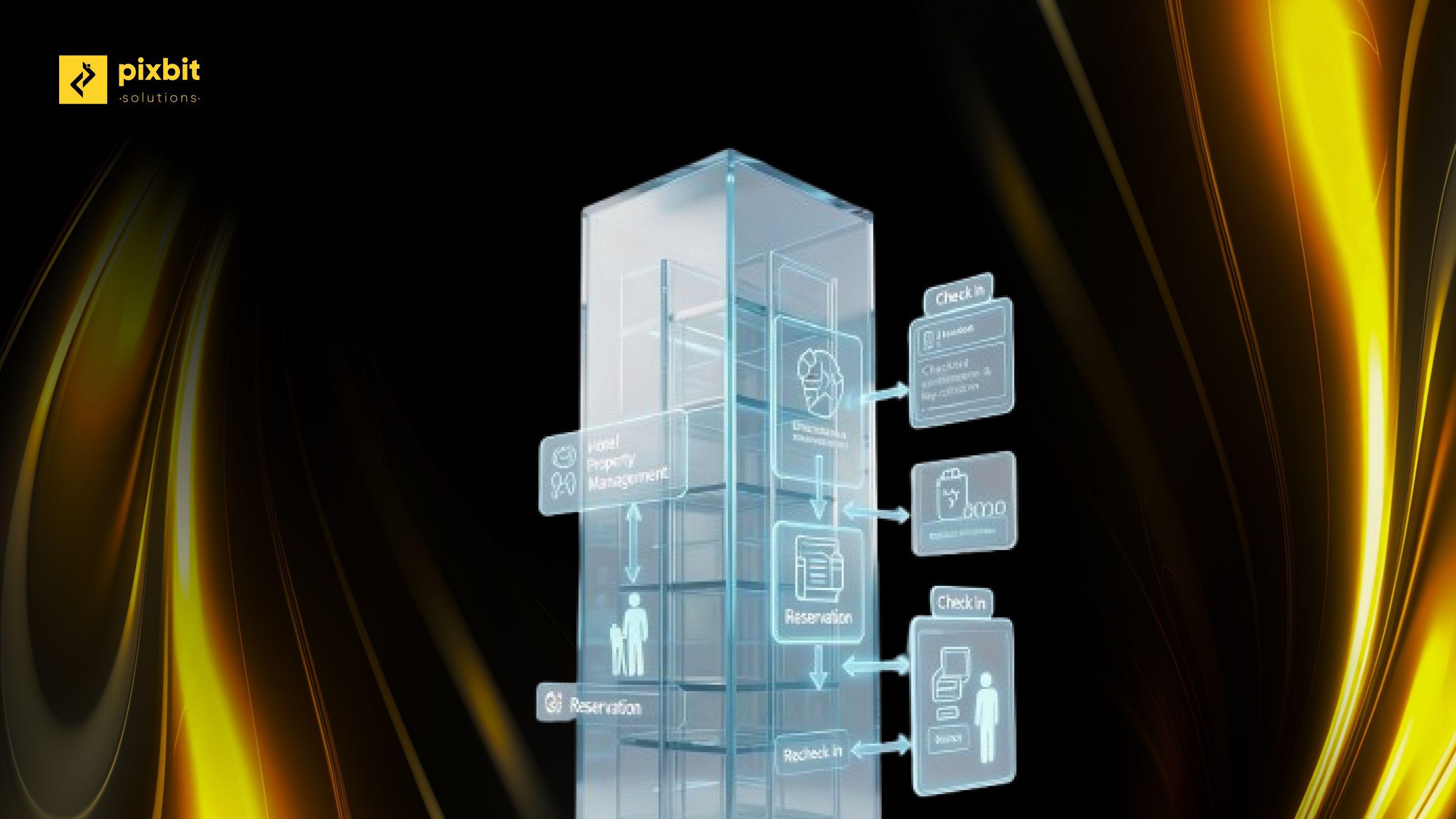
The United States is entering one of the largest hospitality infrastructure cycles in recent history. Between convention center expansions, luxury resort developments, branded extended-stay concepts, and global tourism events like the 2026 FIFA World Cup and the 2028 Los Angeles Olympics, hotel groups are making technology procurement decisions years before opening day.
A hotel launching in 2028 will typically finalize its PMS architecture during 2026–2027. The challenge is that many legacy hospitality systems were built for generic global operations rather than the operational, payment, compliance, and reporting requirements modern U.S. hotel businesses face daily.
This guide explains what a U.S.-focused Property Management System should include, how critical integrations work, which operational modules matter most, and what custom hotel management software development in the USA costs in 2026. At Pixbit Solutions, we build custom hospitality technology ecosystems using Laravel, React, Next.js, and Flutter. Our experience in hospitality app development and operational platforms helps hotel operators move beyond rigid off-the-shelf software limitations.
Why Global PMS Platforms Fall Short for Modern U.S. Hotel Operations
Oracle OPERA, Mews, Cloudbeds, and Protel are mature hospitality systems. They handle standard reservation and front-desk workflows effectively for many properties.
The limitation appears when operators require property-specific automation, multi-property operational visibility, custom guest experiences, ownership-specific reporting, advanced payment workflows, or integration-heavy ecosystems. At that point, extending an off-the-shelf PMS often becomes more expensive and operationally restrictive than building a custom platform.
Most hotel groups encounter friction in five areas:
- ERP and accounting integration depth
- Guest loyalty customization
- Revenue optimization logic
- Multi-property standardization
- Ownership-specific financial reporting
Many enterprise operators eventually realize they are adapting their business processes to fit the PMS rather than the PMS adapting to the business.
The workforce management gap
Labor remains one of the largest operational expenses in U.S. hospitality.
Many PMS products include basic scheduling modules but lack deeper workforce intelligence capabilities such as productivity forecasting, overtime risk analysis, shift optimization, certification tracking, housekeeping workload balancing, and labor forecasting tied directly to occupancy projections.
A custom PMS can connect staffing decisions directly to reservations, event schedules, housekeeping demand, occupancy forecasts, and seasonal booking trends, producing significantly more accurate labor planning across departments.
PCI Compliance, STR Reporting, and Guest Data Security
Unlike hospitality ecosystems that revolve around centralized tourism reporting authorities, U.S. hotel compliance focuses heavily on payment security, privacy obligations, financial accountability, operational reporting, and guest data protection.
Hotels routinely process and manage:
- Passport information
- Driver’s license data
- Credit card tokens
- Loyalty program records
- Corporate billing accounts
- Payment histories
- Guest communication data
Because of this, PCI DSS compliance becomes one of the most important architectural requirements in hotel management software development USA projects.
A properly designed PMS should never store raw payment card information directly. Tokenization must occur through certified payment gateways that reduce PCI scope and lower exposure risk.
Encryption should exist both at rest and in transit. Administrative permissions require strict role-based access controls, comprehensive audit logging, security monitoring, and retention policies aligned with ownership and franchise requirements.
Many hotel groups also integrate STR reporting workflows into executive dashboards for benchmarking occupancy, ADR, and RevPAR performance against competitive sets and regional markets.
The Payment and Financial Layer Every U.S. PMS Needs
PCI-compliant hotel billing
Hotel billing is substantially more complex than standard retail payment processing.
Properties manage room charges, deposits, restaurant spending, spa services, event billing, split folios, group reservations, negotiated corporate rates, incidentals, refunds, and chargebacks simultaneously.
The PMS billing engine must support:
- Authorization and capture workflows
- Pre-authorized deposits
- Folio management
- Split billing
- Corporate invoicing
- Tax calculations
- Refund processing
- Department-level revenue allocation
Every transaction should remain fully traceable through a complete audit trail.
Payment gateway integration
Modern U.S. hotels support multiple payment channels across departments.
Guests expect:
- Visa
- Mastercard
- American Express
- Discover
- Apple Pay
- Google Pay
- Digital wallets
- Corporate virtual cards
Luxury and international properties often require multi-currency display capabilities while settling operational accounts in USD.
A modern PMS should integrate payment workflows directly into reservations, front desk operations, restaurant systems, spa management, guest applications, and mobile check-in experiences rather than relying on disconnected third-party tools.
Pixbit’s experience building a payment platform Pixbit delivered, fintech platform with payment gateway demonstrates the importance of architecting secure payment ecosystems that support multi-channel financial operations and complex transaction workflows.
Operational Modules Generic PMS Platforms Often Ignore
Housekeeping intelligence
Most PMS platforms manage room status updates.
Very few optimize housekeeping operations dynamically.
A modern U.S. hotel PMS should prioritize room assignment automatically based on occupancy forecasts, VIP arrivals, maintenance dependencies, housekeeping workloads, and check-in schedules. Supervisors should receive live operational visibility while attendants receive mobile assignments through dedicated staff applications.
Maintenance and engineering workflows
Engineering departments directly affect guest experience and operational continuity.
A custom PMS should connect maintenance workflows directly to room inventory management. When a room is flagged for maintenance, inventory availability should update immediately across reservation systems and OTA channels.
Preventive maintenance scheduling, vendor coordination, asset lifecycle tracking, and engineering work orders should operate from the same centralized platform.
Revenue optimization
Revenue management has evolved far beyond seasonal pricing updates.
Hotels increasingly adjust rates using:
- Occupancy forecasts
- Local event calendars
- Flight activity
- Competitor pricing
- Convention schedules
- Historical demand patterns
- Regional tourism activity
A custom PMS can integrate machine learning-based forecasting models that recommend pricing adjustments while preserving management approval workflows and ownership controls.
The 12 Modules a U.S. Hotel PMS Must Include
Reservation Management
The reservation engine must synchronize direct bookings, OTA inventory, package rates, group reservations, cancellation rules, and promotional campaigns across multiple booking channels without creating overbooking conflicts. Integration with Booking.com, Expedia, Hotels.com, Airbnb, and direct booking systems becomes critical for inventory consistency.
Front Desk Operations
Front desk workflows should combine digital registration, ID verification, payment authorization, room assignment, guest communication, and key issuance within a unified operational interface. Staff need immediate access to reservation history, guest preferences, and operational alerts during check-in.
Guest Profile Management
Guest profiles become operationally valuable over time. The PMS should consolidate stay history, spending behavior, loyalty participation, room preferences, communication history, and marketing permissions into a centralized guest record.
Housekeeping Management
Housekeeping operations require dynamic task assignment, mobile coordination, inspection workflows, productivity tracking, and supervisor visibility. Real-time room status synchronization reduces delays between housekeeping completion and front desk availability.
Billing and Financial Management
Financial operations must support taxes, folios, deposits, chargebacks, commissions, refunds, corporate accounts, departmental accounting structures, and ownership-specific reporting requirements while maintaining auditability across every transaction.
Payment Processing
Payment infrastructure should support tokenized transactions, recurring billing, contactless payments, digital wallets, integrated settlement reporting, and department-level reconciliation across all hotel operations.
Food and Beverage Integration
Restaurant, minibar, room service, and bar transactions should post directly into guest folios automatically. This reduces reconciliation overhead and eliminates duplicate manual entry across departments.
Events and Banqueting
Meetings, weddings, conferences, and corporate events require scheduling systems, catering coordination, contract management, AV planning, resource allocation, and event-specific billing workflows integrated directly into the PMS.
Revenue Management
Revenue optimization combines demand forecasting, competitor intelligence, occupancy projections, pricing recommendations, and booking behavior analysis to improve ADR and RevPAR performance.
Workforce Management
Employee scheduling, overtime monitoring, labor forecasting, productivity tracking, certification management, and departmental staffing visibility should integrate directly into operational dashboards.
Analytics and Executive Dashboard
General managers require live visibility into occupancy, ADR, RevPAR, departmental profitability, labor costs, booking channel performance, and forecasting metrics from a centralized executive dashboard.
Mobile Operations Platform
Housekeeping teams, maintenance staff, operations managers, and supervisors increasingly rely on mobile-first operational workflows. Offline-capable Flutter applications allow operational continuity during network interruptions.
The 5-Step Build Process
1. Discovery and Operational Audit
Development begins by documenting workflows across reservations, housekeeping, engineering, accounting, events, food and beverage, and executive reporting. Decisions made during this phase determine the platform’s long-term operational flexibility.
2. System Architecture and Integration Planning
The development team maps integrations with payment gateways, accounting systems, booking engines, CRM platforms, loyalty ecosystems, channel managers, and operational vendors before development begins.
3. Core PMS Development
Backend services are typically developed using Laravel while operational dashboards are built using React or Next.js. Mobile operational applications for housekeeping and maintenance teams are commonly developed using Flutter.
4. Payment, Security, and Compliance Layer
PCI tokenization, encryption, security monitoring, audit logging, user permissions, and financial compliance layers are implemented and tested before production deployment.
5. User Acceptance Testing and Rollout
Hotels conduct end-to-end operational testing using real reservation scenarios, guest check-ins, payment workflows, housekeeping operations, maintenance requests, and executive reporting before launch.
Pricing Tiers — What a U.S. Hotel PMS Costs in USD
Tier 1 — Boutique Hotel PMS ($35,000–$75,000)
This tier includes reservations, front desk operations, housekeeping management, payment gateway integration, guest profiles, reporting dashboards, bilingual capability where required, and mobile housekeeping functionality.
Implementation generally requires 12–18 weeks.
Suitable for boutique hotels, independent properties, and smaller extended-stay concepts with fewer than 100 rooms.
Tier 2 — Full-Service Hotel PMS ($85,000–$180,000)
This tier adds advanced billing workflows, workforce management, food and beverage integration, event management, OTA connectivity, corporate account management, and revenue optimization tools.
Implementation generally requires 20–30 weeks.
Designed for full-service hotels and regional hotel groups operating between 100–500 rooms.
Tier 3 — Enterprise Multi-Property PMS ($220,000–$500,000+)
Enterprise platforms include centralized reservation systems, advanced analytics, multi-property operations, machine learning forecasting, guest-facing mobile applications, enterprise-grade security frameworks, and extensive third-party integrations.
Implementation generally requires 28–44 weeks.
Ideal for luxury hospitality brands, destination resorts, institutional operators, and multi-property hotel groups.
Ongoing costs typically include cloud infrastructure, software maintenance, security monitoring, payment gateway fees, integration maintenance, and support contracts.
If you are evaluating a custom hotel PMS initiative, book a discovery call to scope your platform requirements and obtain a tailored estimate for your hospitality portfolio.
5 Mistakes Hotel Operators Make When Building a PMS
Starting with OTA integrations before defining operations
OTA connectivity receives significant attention because it directly affects revenue generation. However, reservation workflows, billing logic, operational hierarchy, housekeeping coordination, and financial structures should be finalized before external integrations begin.
Treating payment security as a later-stage requirement
PCI compliance architecture cannot be retrofitted efficiently after development. Tokenization, audit logging, role-based permissions, and payment isolation should exist at the database and application architecture level from day one.
Building disconnected operational systems
Hotels often operate separate systems for reservations, maintenance, housekeeping, accounting, events, and food and beverage operations. This creates synchronization issues, duplicate reporting, and operational blind spots across departments.
Ignoring multi-property scalability early
Many operators initially build for a single property even when portfolio expansion is planned within 2–3 years. Multi-property architecture decisions become significantly more expensive when introduced later.
Underestimating mobile operational workflows
Housekeeping, maintenance, engineering, and supervisory teams increasingly rely on mobile-first operational processes. A PMS designed primarily around desktop workflows creates operational inefficiencies across large properties.
Why Pixbit Solutions
Pixbit Solutions develops custom operational platforms using Laravel, React, Next.js, and Flutter for businesses that require more flexibility than off-the-shelf software typically allows. Our experience includes fintech payment ecosystems, operational dashboards, mobile workforce applications, and scalable platform architecture across multiple industries.
Our expertise in hospitality app development and travel technology platforms helps us design systems that combine operational efficiency, payment infrastructure, guest experience, and long-term scalability. We also understand that hospitality technology projects require extensive discovery and operational mapping before development begins, which is why we scope projects thoroughly before committing clients to timelines and budgets.
Getting Started
If your hotel group is evaluating custom hotel management software development USA initiatives for properties opening between 2026 and 2032, talk to the team at Pixbit Solutions.
We scope custom PMS builds covering reservations, payments, workforce operations, analytics, housekeeping, and multi-property management from a single discovery session.

Nabeel Al Nassir
Digital Marketer
Share on
Have an idea that needs to go mobile? Launch it with us!
Have an idea that needs to go mobile? Launch it with us!
Let's Talk
You May Also Like
Explore insightful articles and tips from our experts on the latest trends in web development and marketing.

Have an idea ?
Let's make it happen
Tell us your business aspirations, and let's craft a custom solution that drives business growth, ensuring satisfaction and exceeding your goals with precision.
Let's Talk