
DLD API Gateway: Every Real Estate Developer Integration in Dubai Explained
Nabeel Al Nassir
July 4, 2026
4 Min read
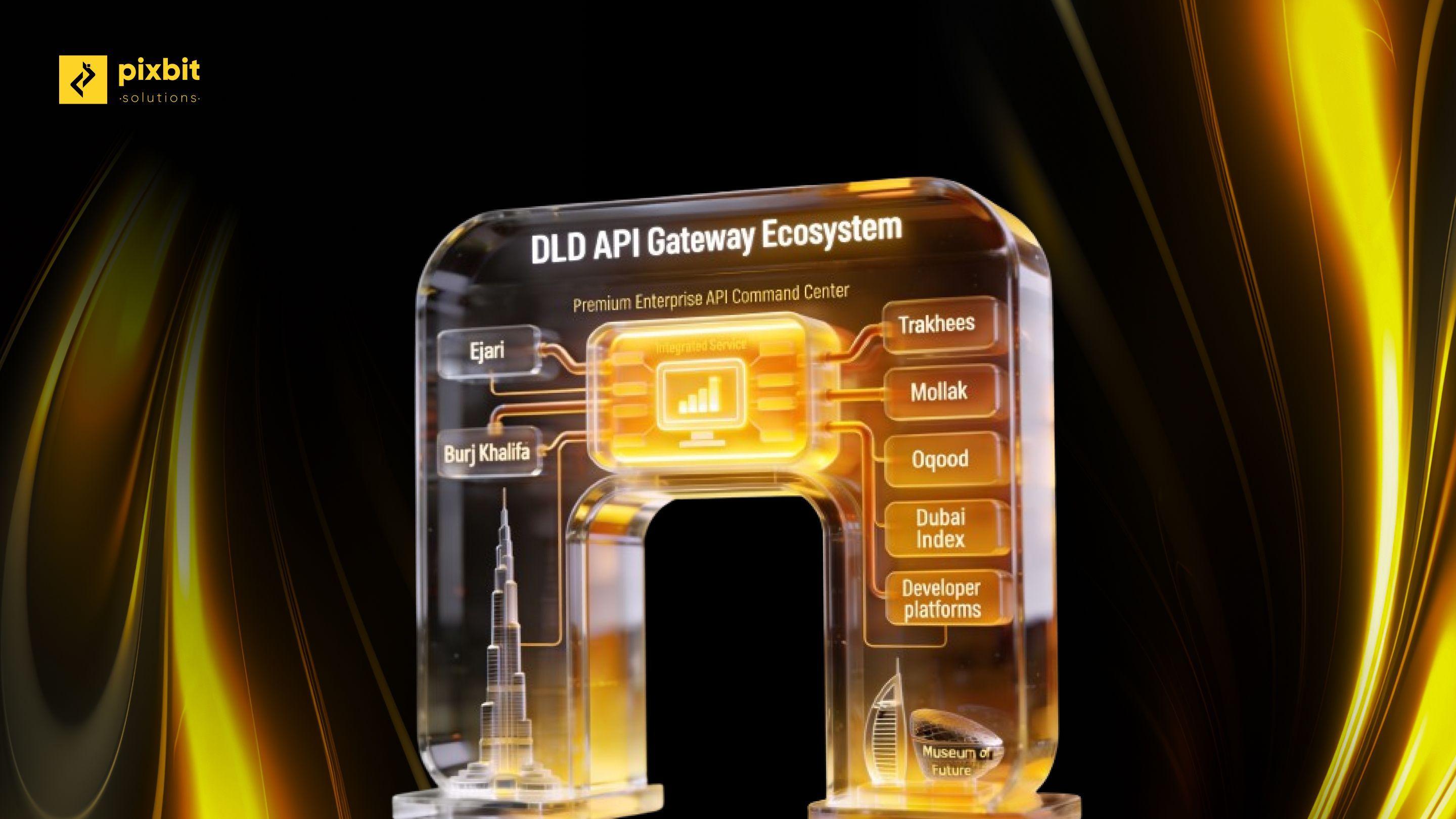
The DLD API Gateway provides programmatic access to Dubai's core real estate compliance ecosystem through a single business authentication environment. Rather than treating Ejari, Mollak, Trakheesi, Oqood, the Rental Index, and other government systems as isolated integrations, developers should architect a shared DLD connection layer with service-specific adapters. This approach reduces duplicated authentication, simplifies future integrations, and creates a scalable foundation for modern UAE real estate software.
Choosing the right government integrations is one of the earliest architectural decisions for any real estate app development Dubai project. At Pixbit Solutions, we regularly help founders, CTOs, and digital transformation teams evaluate which DLD services apply to their business model before development begins. This guide maps every confirmed DLD API Gateway service, explains its purpose, outlines its technical prerequisites, and shows how each fits into a production-grade property platform.
The Shared Architecture — One Login, Nine Services
One of the biggest misconceptions about Dubai government integrations is that every system operates independently. In reality, the Dubai Land Department has built its services around a shared business authentication environment. Once a registered business authenticates through its DLD account, it can access multiple connected services including Ejari, Trakheesi, Oqood, the Rental Disputes Centre (RDC), Registration Trustee services, and Mollak, subject to the permissions and prerequisites associated with each service.
End users authenticate differently. Property owners and tenants typically access government services using Emirates ID, UAE PASS, title deed references, or registered mobile numbers, while consumer-facing interactions increasingly happen through the Dubai REST application.
For software architects, this distinction matters. Authentication for the business integration layer should remain separate from user authentication. The recommended architecture consists of one shared DLD authentication module, with dedicated adapter services responsible for handling Ejari, Mollak, Trakheesi, Oqood, Dubai Brokers, and Rental Index requests individually.
A typical implementation includes Laravel as the backend integration layer, PostgreSQL for audit logging and compliance records, React or Next.js for operational dashboards, Flutter for mobile operations, and Azure UAE North or AWS Middle East for PDPL-compliant hosting.
Ejari API — Tenancy Registration
The Ejari API manages the complete tenancy lifecycle within property management software. Instead of manually registering contracts through the Ejari portal, property managers can automate tenancy issuance, renewals, cancellations, certificate retrieval, and title deed validation directly from their own platforms.
Core API capabilities include:
- Issue Tenancy Contract
- Renew Tenancy Contract
- Terminate Tenancy Contract
- Print Ejari Certificate
- Cancel Registration
- Property Lookup Services
- Title Deed Validation
- Existing Registration Verification
Access is limited to organisations that satisfy several prerequisites:
- Dubai Trade Licence with the appropriate software activity
- Association with a RERA-registered real estate management company
- Active Ejari business registration
- Local UAE office presence
The legal importance of Ejari extends beyond tenancy administration. Every residential and commercial lease in Dubai must be registered before tenants can:
- Activate DEWA
- Renew residence visas
- File Rental Disputes Centre (RDC) cases
During Q1 2026, Dubai processed more than 118,385 new tenancy registrations and 135,607 renewals, highlighting why scalable API automation is becoming increasingly important.
For complete endpoint documentation and implementation guidance, read the Ejari API integration guide for property management.
Mollak and Mollak Budget — Service Charge Compliance
For jointly owned properties (JOPs), Mollak is one of the most important systems within the DLD API Gateway. While Ejari governs tenancy registration, Mollak governs how service charges are calculated, approved, invoiced, collected, and reconciled across apartment communities and mixed-use developments.
A common misconception is that Mollak consists of a single API. In reality, there are two closely related but distinct services:
- Mollak Integration API
- Mollak Budget API
Although they operate together, each serves a different compliance purpose.
Mollak Integration API
The Mollak Integration API synchronises operational and financial data between a property management platform and RERA's mandatory service charge management system.
Typical API services include:
- Budget Sync
- Invoice Sync
- Receipt Sync
- Owner Synchronisation
- Community Tenant Synchronisation
- Additional Invoice Management
- Legal Notice Generation
Instead of manually uploading service charge information into the Mollak portal, management companies can automatically synchronise invoices, receipts, ownership records, and payment updates directly from their internal software.
This greatly reduces duplicate data entry while maintaining regulatory compliance.
Who Needs Mollak Integration?
The API primarily applies to:
- Owners Association (OA) management companies
- Jointly Owned Property (JOP) managers
- Developers managing completed communities
- Enterprise property management platforms
If a platform manages service charges for jointly owned properties in Dubai, Mollak integration is generally mandatory rather than optional.
Legal Foundation
Mollak operates under Law No. 6 of 2019 on Jointly Owned Real Property.
The regulation requires service charge administration to flow through the approved Mollak ecosystem, ensuring transparency for property owners, management companies, auditors, and RERA.
Today, the system supports more than 750,000 jointly owned properties across Dubai.
Mollak Budget API
Many developers incorrectly assume the Budget API is simply another endpoint inside Mollak. It is actually a separate regulatory workflow.
Before any service charge invoice can legally be generated, the property's annual budget must first receive RERA approval.
The Budget API manages this approval lifecycle.
Typical workflow includes:
- Annual budget creation
- Budget revision submission
- RERA review tracking
- Approval confirmation
- Budget status monitoring
Only after a budget receives approval can Invoice Sync begin processing service charge invoices.
From a software architecture perspective, the relationship looks like this:
Annual Budget
      │
      ▼
Budget API Submission
      │
      ▼
RERA Review
      │
      ▼
Budget Approved
      │
      ▼
Invoice Sync Enabled
      │
      ▼
Receipt Sync
Attempting to generate invoices without an approved budget causes submissions to fail regardless of how well the Invoice API itself has been implemented.
For this reason, production-grade OA management platforms always implement the Budget API before enabling invoice automation.
Technical Prerequisites
Unlike Ejari, Mollak has additional eligibility requirements.
Businesses generally require:
- Valid Dubai Trade Licence
- Local UAE office presence
- Active DLD business account
- Association with a RERA-licensed JOP management company
- FTA Accredited Software Vendor status for the accounting component
The accounting accreditation requirement is unique to Mollak and often becomes the longest administrative dependency before integration can begin.
Development teams should confirm these prerequisites during project discovery rather than after implementation has started.
For a complete technical walkthrough of endpoints, authentication, workflows, and implementation architecture, read our complete Mollak API integration guide.
If you're building community management software from scratch, our OA management app build guide also explains how Mollak fits into the overall platform architecture.
Oqood / TAS — Off-Plan Sales Registration
While Ejari governs tenancy and Mollak governs completed communities, Oqood focuses on Dubai's off-plan real estate sector.
Every off-plan property sale must be registered through the Oqood system within the legally prescribed timeframe, making it one of the most important integrations for developer CRMs and off-plan sales platforms.
Oqood Registration Workflow
The complete Oqood registration process typically follows six stages:
SPA Signed
      │
      ▼
Oqood Submission
      │
      ▼
Unit Survey Request
      │
      ▼
Escrow Account Verification
      │
      ▼
DLD Review
      │
      ▼
Fee Payment
      │
      ▼
Oqood Certificate Issued
Each stage introduces validation requirements that software should automate wherever possible, including document verification, milestone tracking, application status monitoring, payment notifications, and certificate retrieval.
Developer Prerequisites
Unlike Ejari or Mollak, Oqood access is only available to organisations recognised as registered developers.
Prerequisites include:
- Active DLD business account
- Registered developer status within Oqood
- Valid Dubai Trade Licence
- Local UAE office presence
- Project approval from relevant authorities
Without recognised developer status, API access cannot be provisioned regardless of software readiness.
Legal Framework
Oqood operates under Law No. 13 of 2008, as amended, governing off-plan property registration in Dubai.
Every Sale and Purchase Agreement (SPA) must generally be registered within 60 days.
Failure to comply may result in:
- Financial penalties reaching AED 100,000
- Potential legal action
- Delays in title registration
- Increased regulatory scrutiny
Alongside Oqood, Law No. 8 of 2007 governs escrow accounts for off-plan developments. While Oqood records ownership transactions, escrow regulations ensure buyer funds are released only after verified construction milestones have been achieved.
Together, these systems provide both ownership transparency and financial protection for purchasers.
For a deeper explanation of escrow workflows, compliance architecture, and developer software requirements, read our RERA escrow compliance software guide.
Trakheesi and the Dubai Brokers API — Listing and Licence Integrity
Publishing a property advertisement in Dubai involves more than uploading photos and pricing.
Before a listing becomes publicly visible, two separate compliance checks should occur:
- Company-level advertising permit validation through Trakheesi
- Individual broker licence verification through the Dubai Brokers API
Although these systems are closely related, they solve different regulatory problems.
Trakheesi System
Trakheesi manages Dubai's real estate advertising compliance.
Every online and offline property advertisement must carry a valid Trakheesi permit before publication.
The platform provides services including:
- Advertising permit issuance
- Permit validation
- Madmoun QR code generation
- Electronic broker card services
- Permit renewal management
The Madmoun QR Code has become particularly important because it allows prospective buyers to verify property advertisements directly against DLD records.
Who Should Integrate Trakheesi?
The integration applies to:
- Property listing portals
- Brokerage CRMs
- Developer sales portals
- Marketplace platforms
- Marketing automation systems
- Lead management platforms
Permit Costs and Processing
Typical permit processing includes:
- AED 1,000 permit fee
- AED 20 service charge per permit
- Approximately one working day processing time
Legal Importance
Under Law No. 7 of 2013, publishing property advertisements without valid permits can result in:
- Fines beginning at AED 50,000
- Repeat offences exceeding AED 100,000
- Potential licence suspension
- Licence cancellation for repeated violations
For developers, this changes software architecture.
A compliant platform should validate permit status before allowing publication—not afterwards.
Waiting until listings are already live creates unnecessary compliance exposure.
(Future Link: TRAKHEESI-GUIDE)
Dubai Brokers API
Where Trakheesi validates advertisements, the Dubai Brokers API validates people.
It provides real-time access to:
- Individual broker licence status
- Broker card details
- Office registration details
- Company registration status
Typical use cases include:
- Verifying broker licences before assigning leads
- Confirming broker eligibility before listing publication
- Validating office registration during onboarding
- Preventing expired brokers from receiving enquiries
Many platforms mistakenly perform only the Trakheesi check.
In reality, both validations should occur together:
Property Listing
       │
       ▼
Validate Trakheesi Permit
       │
       ▼
Validate Broker Licence
       │
       ▼
Generate Madmoun QR
       │
       ▼
Publish Listing
This two-step workflow significantly reduces regulatory risk while ensuring every published property complies with Dubai's advertising requirements.
Rental Index API — Compliance Built Into Renewal Workflows
The Rental Index API is one of the most frequently overlooked DLD integrations, yet it plays a critical role in ensuring lease renewals remain compliant with Dubai regulations.
Since the rollout of the RERA Smart Rental Index in January 2025, permitted rent increases are no longer based on static tables or periodically updated spreadsheets. Instead, they are calculated using continuously updated market data derived from live Ejari registrations across Dubai.
For software developers, this means rental calculations should always reference the latest Rental Index data rather than relying on hardcoded business rules.
What the Rental Index API Provides
The API enables software to retrieve current rental benchmark information for a specific property before generating a renewal contract.
Typical use cases include:
- Rental renewal calculations
- Market rent validation
- Rental valuation tools
- Property portfolio analytics
- Lease negotiation workflows
- Compliance checks before renewal
Rather than estimating market rent manually, the platform can request live pricing intelligence directly from the DLD ecosystem.
Smart Rental Index Integration
The Smart Rental Index evaluates numerous market variables, including:
- Community
- Building
- Unit type
- Current tenancy data
- Recent Ejari registrations
- Comparable rental transactions
Using this information, the system determines whether a landlord is legally permitted to increase rent.
Unlike older rental calculators, the Smart Rental Index continuously evolves as new tenancy registrations are processed.
Permitted Increase Bands
The Rental Index determines one of five legally recognised rent increase bands:
| Difference from Market Rate | Maximum Rent Increase |
|---|---|
| Close to market value | 0% |
| Moderately below market | 5% |
| Significantly below market | 10% |
| Well below market | 15% |
| Substantially below market | 20% |
These percentages should never be hardcoded into software.
Only the legal framework remains constant—the applicable band for a specific property changes as live market data changes.
Why Live API Calls Matter
A common implementation mistake is downloading Rental Index values once and storing them locally.
While this may appear to improve performance, it introduces compliance risk.
Because the Smart Rental Index continuously updates using live Ejari transaction data, cached values gradually become outdated.
A compliant renewal workflow should instead follow this sequence:
Lease Renewal Requested
          │
          ▼
Retrieve Current Rental Index
          │
          ▼
Calculate Permitted Increase
          │
          ▼
Generate Renewal Contract
          │
          ▼
Present to Landlord & Tenant
Every renewal should trigger a fresh API request before the new rental amount is calculated.
This ensures the generated tenancy agreement reflects the most recent regulatory guidance rather than historical market conditions.
For additional context on how Rental Index data fits into broader investment and property management platforms, see our Dubai property portfolio management app.
The Bank-Restricted Services — Virtual Account and Supplier Details APIs
While most DLD API Gateway services are designed for developers, brokers, and property managers, two services primarily support trustee banks that operate regulated financial infrastructure within Dubai's real estate ecosystem.
Although many software vendors will never connect to these APIs directly, understanding their purpose helps architects design better reconciliation and payment workflows.
Virtual Account API
The Virtual Account API allows DLD-approved trustee banks to manage community virtual accounts used for service charge collection.
Typical capabilities include:
- Virtual account creation
- Account closure
- Credit notification events
- Payment confirmation
- Real-time account monitoring
These APIs are generally restricted to authorised trustee banks rather than commercial software vendors.
However, property management platforms often consume the resulting banking events during reconciliation.
For example, when a property owner pays service charges through SADAD or another approved payment channel, the trustee bank can identify which virtual account received the funds before synchronising payment confirmation back into the property management platform.
Supplier Details API
The Supplier Details API supports another important financial control.
Rather than validating incoming payments, it validates outgoing disbursements.
The API provides trustee banks with information about RERA-approved suppliers associated with an approved community budget.
Typical information includes:
- Approved contractors
- Maintenance companies
- Cleaning vendors
- Security providers
- Budget allocations
- Community approval status
Before releasing service charge funds, banks can verify that a contractor appears on the approved supplier list for the relevant community.
This additional validation reduces the risk of unauthorised payments and improves financial transparency within the Mollak ecosystem.
Although these APIs are bank-facing services, developers building enterprise-grade OA management platforms should understand how trustee bank reconciliation fits into the wider DLD architecture.
The Adjacent Layer — DEWA and Noqodi
Not every government-related integration comes directly from the DLD API Gateway.
Two services are frequently implemented alongside DLD integrations because they complete the operational workflow.
DEWA API
DEWA integration is commonly used immediately after successful Ejari registration.
Typical functions include:
- Utility connection requests
- Electricity activation
- Water activation
- Consumption monitoring
- Customer account management
For many tenants, the operational workflow naturally progresses from Ejari registration to DEWA activation.
Noqodi Integration
Noqodi is not part of the DLD API Gateway itself, but it remains one of the most important adjacent integrations for Dubai real estate software.
It is widely used for:
- Service charge payments
- Government fee collection
- Developer payments
- Property management billing
- Secure online payment processing
Within Mollak-based platforms, Noqodi frequently acts as the approved payment rail that completes the financial workflow after invoices have been generated.
Developers designing enterprise property management systems therefore often integrate:
- DLD APIs for regulatory compliance
- Noqodi for payment processing
- DEWA for utility activation
Working together, these integrations create a complete digital property lifecycle.
For implementation guidance, architecture recommendations, and payment workflows, read our Noqodi payment integration guide.
The Pre-Requisite Pattern — What to Confirm Before Scoping
One of the biggest reasons DLD integration projects stall is not technical complexity—it is discovering halfway through development that the client is not yet eligible to access the required APIs.
Each DLD service serves a different segment of Dubai's real estate industry, and each has its own business registration requirements. Before any architecture is designed or API credentials are requested, development teams should confirm that the organisation satisfies every regulatory pre-requisite.
Failing to perform this audit early can delay projects by several weeks while licences, approvals, or company registrations are completed.
Ejari API Requirements
The Ejari API is available only to organisations operating as registered real estate management companies.
Typical requirements include:
- Dubai Trade Licence with appropriate activity codes
- Real estate management company registration
- Active Ejari business account
- Local UAE office presence
- DLD business account credentials
Without these approvals, API access requests will not proceed.
Mollak API Requirements
Mollak has additional requirements because it governs jointly owned property (JOP) service charge management.
Organisations generally require:
- RERA-licensed JOP management company status
- Dubai Trade Licence
- Local UAE office
- Active DLD business account
- FTA Accredited Software Vendor status for the accounting component
This final requirement is particularly important for software vendors integrating financial workflows into OA management platforms.
Oqood Requirements
Oqood integrations apply only to registered developers selling off-plan property.
Requirements include:
- Registered developer status
- Active Oqood registration
- Dubai Trade Licence
- DLD business account
- Approved project registration
Without recognised developer status, no API integration can begin regardless of the software architecture.
Shared Requirements Across Most Services
Although every DLD API has unique conditions, several requirements appear consistently throughout the ecosystem.
Most organisations will need:
- Active Dubai Trade Licence
- Local UAE office
- DLD Business Account
- Appropriate real estate licence category
- Organisation-specific regulatory approvals
This shared authentication model is why modern DLD platforms should implement one secure business authentication layer with modular service adapters rather than treating every integration as an independent system.
Why This Matters Before Development Starts
Many organisations assume API integration begins once software development starts.
In reality, regulatory readiness often determines the delivery timeline more than engineering effort.
For example:
- A property management company without Ejari registration cannot immediately integrate Ejari.
- An OA management company without FTA accreditation cannot complete Mollak accounting integration.
- A brokerage cannot publish compliant property advertisements without Trakheesi permissions.
- A developer without active Oqood registration cannot automate off-plan registration workflows.
These administrative processes typically cannot be accelerated by the software development team.
Performing a compliance audit before architecture planning prevents expensive project delays later.
The Full DLD API Gateway at a Glance
The table below summarises the primary DLD API Gateway services, the platforms they support, and the key eligibility requirements developers should verify before scoping a project.
| DLD API Service | Typical Platform | Key Pre-requisite |
|---|---|---|
| Ejari API | Property management software, landlord platforms | Registered real estate management company |
| Mollak Integration API | Owners association platforms, JOP management systems | RERA-licensed JOP management company and FTA Accredited Software Vendor status |
| Mollak Budget API | OA management software | Same requirements as Mollak Integration API |
| Oqood / TAS | Off-plan developer CRM and sales platforms | Registered developer status within Oqood |
| Trakheesi System | Listing portals, brokerage CRMs, developer portals | Licensed real estate company with active DLD account |
| Dubai Brokers API | Brokerage CRM, listing management platforms | Active DLD Business Account |
| Rental Index API | Property management platforms, renewal workflows | Active DLD Business Account |
| Virtual Account API | Trustee banking platforms | DLD-authorised trustee bank |
| Supplier Details API | Bank-integrated financial platforms | Trustee bank authorisation |
Rather than viewing these as isolated integrations, enterprise platforms should consider them components of a unified regulatory ecosystem connected through a shared DLD authentication layer.
How Much Does DLD API Integration Cost in AED?
The cost of DLD API integration depends less on the APIs themselves and more on the surrounding workflows, compliance validation, authentication architecture, and testing requirements.
Typical implementation costs include:
| Integration Scope | Typical Investment (AED) |
|---|---|
| Single DLD API Integration | 20,000–60,000 |
| Compliance Workflow Integration | 50,000–120,000 |
| Multiple Connected DLD Services | 120,000–300,000+ |
| Enterprise Real Estate Platform with Multiple Government Integrations | 300,000+ |
These figures generally include:
- Authentication architecture
- Backend integration
- Validation workflows
- Error handling
- Compliance logging
- User interface integration
- Quality assurance
- Production deployment
Projects involving several DLD services benefit significantly from designing a shared integration layer rather than implementing each API independently.
For a broader breakdown of development pricing, read our guide to real estate software development cost in AED.
If you're planning multiple government integrations, it's often worthwhile to book a discovery session before finalising project scope.
5 Mistakes Developers Make Across DLD Integrations
1. Building Separate Authentication for Every API
The DLD API Gateway is designed around a shared business account architecture. Creating separate authentication layers for Ejari, Mollak, Trakheesi, and Oqood introduces unnecessary duplication and significantly increases long-term maintenance effort.
2. Assuming Every API Shares the Same Eligibility Requirements
Each integration has its own regulatory pre-requisites.
Ejari requires a registered real estate management company, Mollak requires a licensed JOP management company, and Oqood requires registered developer status.
Verifying these conditions after development begins often delays projects by several weeks.
3. Publishing Listings Before Validating Trakheesi and Broker Status
A compliant listing workflow should verify both:
- Trakheesi advertising permit
- Broker licence via the Dubai Brokers API
before any property becomes publicly visible.
Running validation after publication creates the compliance window that regulators penalise.
4. Hardcoding Rental Index Rules
Although the permitted rent increase bands remain fixed, the underlying market calculations change continuously.
Renewal software should always query the Rental Index API live rather than relying on cached values or historic datasets.
5. Treating the Mollak Budget API as Optional
Many teams prioritise Invoice Sync while postponing Budget Sync.
In practice, RERA approval of the annual budget is what enables compliant invoicing.
Without an approved budget, invoice submissions fail regardless of how well the remaining integration has been implemented.
Why Pixbit Solutions
Building software for Dubai's real estate sector requires more than API integration expertise—it requires understanding how government systems interact, where compliance dependencies exist, and how to design an architecture that remains maintainable as regulations evolve.
At Pixbit Solutions, we build enterprise-grade real estate platforms using Laravel, React, Next.js, and Flutter, with a modular integration architecture that separates shared DLD authentication from service-specific adapters. This approach reduces duplicated code, simplifies future API updates, and makes adding new government services significantly easier.
Our team has delivered 148+ projects across 20+ countries and has published in-depth technical resources covering Ejari API and Mollak API integrations for UAE real estate software. Every DLD integration project begins with a pre-requisite audit—confirming licensing, business registration, and regulatory readiness before architecture decisions are made.
Whether you're building a brokerage CRM, property management platform, OA management software, or an off-plan developer portal, the objective is the same: create a compliant platform that is easier to maintain as Dubai's regulatory ecosystem continues to evolve.
[FUTURE LINK: CAT-1 – Custom Real Estate Software Development Dubai]
Getting Started
The DLD API Gateway isn't a single integration—it's an interconnected ecosystem of compliance services that support tenancy registration, service charge management, off-plan sales, advertising permits, broker verification, rental compliance, and financial workflows.
Choosing the right APIs depends entirely on your business model, licensing status, and operational requirements.
If you're planning a UAE real estate platform and want to understand which DLD API integrations your project actually requires before development begins, book a discovery session with Pixbit Solutions.
We begin every engagement with a DLD integration assessment, mapping your platform requirements, confirming regulatory eligibility, identifying integration dependencies, and recommending an architecture built for long-term scalability—not just initial deployment.

Nabeel Al Nassir
Digital Marketer
Share on
Have an idea that needs to go mobile? Launch it with us!
Have an idea that needs to go mobile? Launch it with us!
Let's Talk
You May Also Like
Explore insightful articles and tips from our experts on the latest trends in web development and marketing.




Have an idea ?
Let's make it happen
Tell us your business aspirations, and let's craft a custom solution that drives business growth, ensuring satisfaction and exceeding your goals with precision.
Let's Talk