
UAE Government API Integration Services
Nabeel Al Nassir
August 31, 2026
5 Min read

Pixbit builds and integrates software against UAE government systems covering property, utilities, payments, digital identity, healthcare, customs, workforce, and compliance workflows. These integrations are treated as part of the application architecture rather than one-off technical add-ons. Whether a platform needs Ejari and Mollak connectivity, UAE Pass authentication, FTA e-invoicing, Dubai Customs workflows, or regulated payment infrastructure, the integration layer is designed around the business process that depends on the government service.
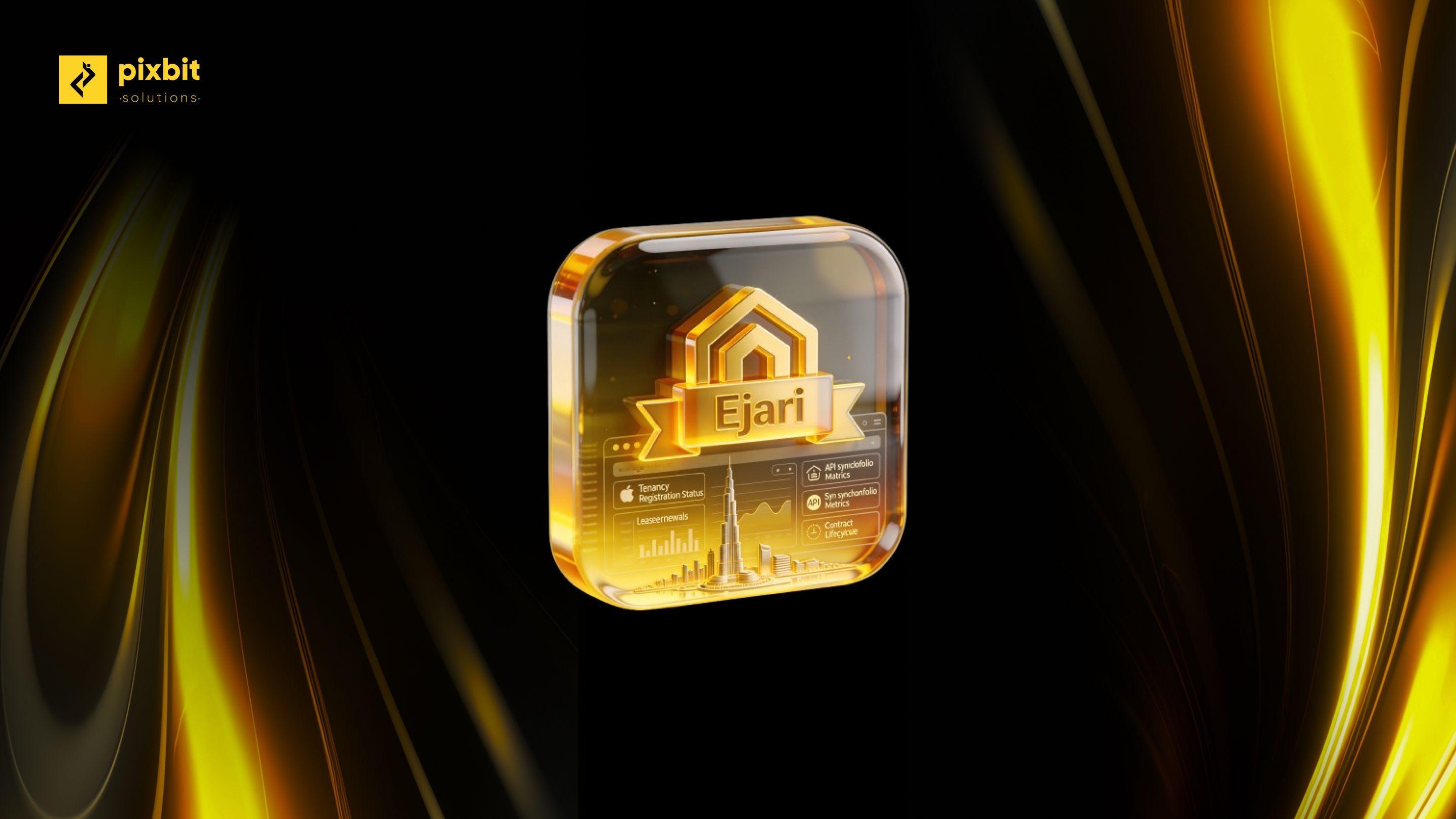
Ejari API Integration
Ejari is Dubai's tenancy registration system and a core government touchpoint for property management companies, landlords, real estate operators, and PropTech platforms. An Ejari-connected platform can incorporate tenancy registration, contract information, renewals, document workflows, and compliance status into the broader lease lifecycle instead of forcing operations teams to move information manually between property software and government portals.
The integration becomes particularly valuable when Ejari is connected to other property workflows. A tenancy record may trigger DEWA-related processes, tenant onboarding, rent schedules, document generation, renewal notifications, and accounting updates. That makes Ejari less of an isolated registration feature and more of a government integration inside the property platform's operating model.
Pixbit's technical guide covers the architecture and workflow in greater detail: Ejari API Integration for Dubai Property Management Software.
DEWA Smart Home Integration
DEWA integration connects Dubai property, facility, and smart-building software with utility-related information such as electricity and water consumption, billing, account relationships, and smart-meter data. It is relevant to property managers, landlords, developers, facility operators, and PropTech platforms that need utility information to sit alongside tenancy, maintenance, financial, and building data.
The architecture needs to account for an important distinction: not every DEWA digital capability is necessarily available as an unrestricted public API. Depending on the workflow, approved digital channels, enterprise arrangements, authenticated services, structured exports, or administrative processes may be involved. Software should therefore support automated integration where available while retaining controlled fallback workflows where direct API access is not applicable.
Pixbit's DEWA Smart Home Integration developer guide explains how utility data can be mapped into a property platform without tightly coupling the application's business logic to DEWA-specific interfaces.
Mollak API Integration
Mollak is Dubai Land Department's central system for managing owners' association service charges, budgets, financial records, and related information for jointly owned properties. Property management companies, Owners Associations, and software platforms supporting jointly owned developments may need Mollak connectivity as part of their operational and financial workflows.
A proper integration can connect service-charge budgets, invoices, receipts, ownership information, financial records, and related operational data with the property management system. The objective is not simply to reproduce Mollak inside another dashboard. The application should maintain its own operational workflows while synchronizing the relevant records through the approved integration layer.
This becomes particularly important when a property platform already contains buildings, units, owners, tenants, suppliers, accounting records, and service-charge workflows. Mollak can then become the government-facing component of a broader OA management architecture.
See Pixbit's Mollak API Integration guide for the deeper API, prerequisite, and property-management architecture.
Trakheesi Integration
Trakheesi is central to Dubai real estate advertising and broker compliance workflows. Real estate brokerages, property portals, marketing platforms, and PropTech systems can use Trakheesi-related integration to connect property listings and advertising operations with permit and broker information.
The important software problem is keeping permit information connected to the listing lifecycle. A brokerage may create a property listing inside its CRM, distribute it to portals and social channels, modify the advertisement, or remove it from publication. The corresponding permit status needs to remain associated with the property and advertisement rather than being maintained in a separate spreadsheet.
A properly designed integration can help the brokerage validate permit-related information before publishing and maintain the relationship between listings, brokers, advertising records, and compliance data.
Pixbit's Trakheesi integration guide covers permit management, broker e-cards, RERA-related workflows, and the architecture required for Dubai real estate software.
DLD API Gateway
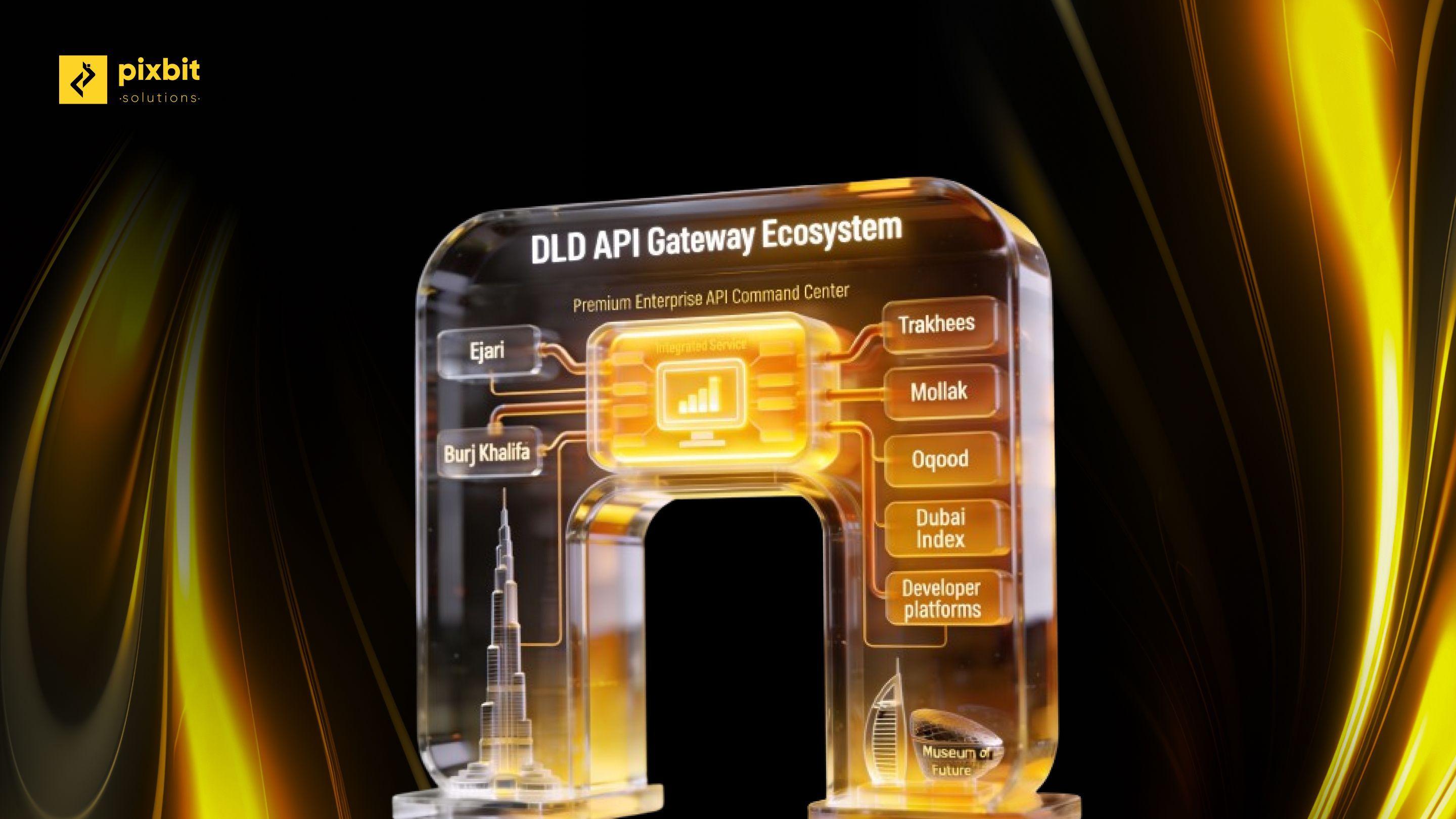
The DLD API Gateway acts as an umbrella integration layer for businesses building software around Dubai's real estate ecosystem. Developers, property technology companies, brokerages, property managers, and other real estate operators may need multiple DLD-connected services rather than one isolated government interface.
The value of an API gateway architecture is that different government workflows can be incorporated into a common software platform while maintaining clear boundaries between business logic and external services. A developer platform, for example, may need property and project information alongside Oqood, escrow, Mollak, Ejari, or other DLD-connected workflows.
Instead of building every integration directly into individual application modules, the platform can use a dedicated government integration layer. This allows authentication, request handling, response validation, error management, logging, and data mapping to remain centralized.
Pixbit's DLD API Gateway guide provides the broader architecture for integrating Dubai real estate systems.
RERA Escrow Integration
RERA escrow-related software supports Dubai off-plan developers managing project-specific financial controls, buyer collections, construction milestones, fund releases, and audit records. The requirement is broader than simply connecting a bank account to an ERP. The software needs to maintain the relationship between buyer payments, registered units, project budgets, construction progress, approvals, and escrow transactions.
A developer platform may use milestone information to determine whether a release is eligible, associate payments with individual buyers and units, reconcile trustee-bank records, and preserve the evidence required for later audit review. These workflows become increasingly difficult to manage when project finance, engineering approvals, buyer records, and government reporting operate in disconnected systems.
Pixbit's RERA Escrow Compliance Software guide explains how escrow controls, milestone workflows, financial reconciliation, TAS-related reporting, and audit records can be incorporated into developer software.
UAE Pass / myID Integration
UAE Pass provides a national digital identity layer that can be integrated into applications requiring authenticated user access and identity verification. It is relevant to government-facing portals, regulated business applications, enterprise platforms, customer portals, and services where users need a trusted UAE digital identity rather than a completely separate username-and-password account.
From a software perspective, the integration typically involves authentication, OAuth-based authorization flows, identity information exchange, token management, session handling, and secure account linking. The application still needs its own authorization model because successful UAE Pass authentication does not automatically determine what a user is permitted to do inside the business application.
For businesses with existing customer or employee accounts, identity mapping is also important. The platform needs to associate the authenticated identity with the correct internal user without creating duplicate accounts or weakening access controls.
Pixbit's UAE Pass API Integration Developer Guide covers the authentication architecture and implementation considerations in detail.
FTA E-Invoicing and PINT AE
UAE e-invoicing integration connects business software with the country's electronic invoicing framework and the PINT AE specification. It is relevant to ERP systems, accounting platforms, billing software, marketplaces, enterprise applications, and businesses that need their invoicing workflows to produce structured electronic invoices through the required ecosystem.
The important architectural change is that e-invoicing should not be treated as simply generating a PDF invoice and emailing it to a customer. The application needs structured invoice data that can be transformed into the required electronic format and passed through the applicable service-provider and network architecture.
This affects invoice data models, tax information, customer identifiers, line items, validation, digital signatures where applicable, document status, error handling, and audit records. Businesses integrating e-invoicing into an existing ERP should therefore assess whether the current invoice database can support the required structured data before implementation begins.
Pixbit's UAE E-Invoicing API Integration Developer Guide provides the technical implementation context for PINT AE, ASP connectivity, XML structures, signatures, and related workflows.
Dubai Customs / Dubai Trade Integration
Dubai Customs and Dubai Trade integrations are relevant to e-commerce businesses, importers, exporters, logistics companies, freight operators, marketplaces, and enterprise platforms managing cross-border shipments. Customs processes generate data that often needs to connect directly with orders, shipment records, invoices, product information, declarations, and fulfilment workflows.
For an e-commerce platform, the integration boundary may sit between order management and customs processing. Product and shipment information generated by the commerce system can feed the appropriate logistics workflow while customs-related statuses and documentation can flow back into the order or shipment record.
This prevents operations teams from maintaining a separate customs workflow that has no connection to the customer's order lifecycle. It also gives the business a structured record of shipment status, customs events, documentation, and related transactions.
Pixbit's Dubai Customs API Integration guide focuses on integrating customs workflows with UAE e-commerce and logistics software.
Malaffi / NABIDH Healthcare Integration
Malaffi and NABIDH are healthcare information-exchange ecosystems serving Abu Dhabi and Dubai respectively. Healthcare providers, clinics, hospitals, laboratories, pharmacies, and healthcare software vendors may need interoperability between their clinical applications and the relevant emirate's health-information infrastructure.
The technical challenge is not simply sending patient information through an API. Healthcare systems need structured clinical data, secure identity and access controls, audit logging, encryption, interoperability standards, and carefully governed data flows. The internal healthcare application also needs a data model capable of representing the clinical records that must be exchanged.
Malaffi integration projects in Abu Dhabi also sit alongside cybersecurity and governance requirements that influence the software architecture before interoperability begins. Pixbit's Malaffi Integration Healthcare Software Development guide explains the relationship between ADHICS requirements, HL7 FHIR interoperability, security architecture, and Malaffi connectivity.
For Dubai healthcare systems, NABIDH can similarly become part of the interoperability architecture, with the exact implementation depending on the provider, system, and applicable DHA requirements.
Noqodi Payment Integration
Noqodi provides a UAE digital payment infrastructure that can be incorporated into existing business software. Property platforms, customer portals, enterprise billing systems, marketplaces, service platforms, and applications managing invoices or collections can use Noqodi as a payment channel rather than creating an entirely separate payment experience.
The software integration typically starts when the business application creates a payable transaction such as an invoice, rent demand, booking, service fee, or other charge. The backend then initiates the applicable payment flow, receives the transaction result, validates it, and updates the internal order or financial record.
The important part is reconciliation.
A payment should not simply change an invoice status to "paid." The application should preserve the transaction reference, payment status, timestamps, amount, customer relationship, and reconciliation state so finance teams can trace the payment back to the original business transaction.
Pixbit's Noqodi Integration UAE guide explains how Noqodi can be incorporated into existing ERP, CRM, property, marketplace, and customer-portal software.
CBUAE Digital Wallet and SVF Integration
Digital wallet platforms operating in the UAE can fall within the regulatory environment governed by the Central Bank of the UAE, including the Stored Value Facilities framework where applicable. This makes wallet development different from adding a conventional payment gateway to an ordinary application.
A wallet platform may need to manage customer identity, balances, transactions, top-ups, withdrawals, payment flows, transaction histories, limits, reconciliation, security controls, and regulated operational processes. The software architecture therefore needs to be designed around the applicable licensing and regulatory model rather than treating the wallet as another CRUD application.
For businesses exploring a regulated digital wallet, the technology assessment should happen alongside the licensing and compliance assessment. The exact scope depends on the service model, customer type, transaction flows, and regulatory permissions involved.
Pixbit's UAE Digital Wallet App Development and CBUAE SVF guide covers the technology and architecture considerations for UAE digital-wallet platforms.
Why Businesses Often Need Multiple Government Integrations
Government integrations rarely exist in isolation when they are part of a larger business platform.
Consider a Dubai property management system.
Ejari can sit inside the tenancy-registration workflow. DEWA can connect utility information to the same tenancy and property records. Mollak can handle owners' association service-charge processes. DLD services can provide the wider real-estate integration layer. Payments may then flow through a UAE payment service while accounting and ERP systems maintain the financial records.
The business does not experience these as five separate software projects.
It experiences one property lifecycle.
A tenant signs a contract, the tenancy is registered, utility information is associated with the unit, rent and service charges are tracked, payments are collected, and the relevant records are maintained across the operational platform.
The same principle applies outside property.
An e-commerce platform may combine Dubai Customs integration, payment services, ERP synchronization, identity management, and e-invoicing. A healthcare platform may combine identity, clinical interoperability, security, and payment workflows. A regional HR platform may need separate workforce integrations for different countries.
This is why government API integration should be treated as an architectural capability rather than a checklist of disconnected connectors.
Building a UAE Government Integration Layer
A scalable government-integrated platform should isolate external systems from the core business application.
The integration layer can manage authentication, credentials, API requests, response mapping, validation, retries, rate limits, logging, error handling, document exchange, and government-specific data structures.
The business application then works with its own internal data model.
For example, the property module should understand a tenancy, tenant, property, contract, utility account, and payment. It should not need to understand every external API field used by Ejari or DEWA.
This separation makes future changes easier to manage.
If an external government service changes its authentication mechanism, endpoint structure, response format, or integration requirement, the change can be contained within the corresponding connector rather than forcing modifications throughout the business application.
It also makes multi-government platforms easier to test.
Each integration can have its own sandbox, test suite, error-handling rules, credentials, and deployment process while the wider application continues using consistent internal business objects.
UAE Government API Integration Summary
| Integration | What It Enables | Who Needs It |
|---|---|---|
| Ejari | Tenancy registration and related lease workflows | Property managers, landlords, brokerages, PropTech platforms |
| DEWA | Utility accounts, billing, consumption, and smart-building data | Property managers, developers, facility operators, smart-building platforms |
| Mollak | OA service charges, budgets, receipts, and financial reporting | Owners Associations, OA managers, property management companies |
| Trakheesi | Real estate advertising permits and broker-related workflows | Dubai brokerages, property portals, PropTech platforms |
| DLD API Gateway | Broader Dubai real-estate government connectivity | Developers, brokerages, property managers, PropTech companies |
| RERA Escrow | Project escrow, buyer collections, milestones, and audit workflows | Off-plan developers and property ERP providers |
| UAE Pass / myID | Digital identity and authenticated access | Government-facing portals, enterprise apps, regulated services |
| FTA E-Invoicing | Structured electronic invoicing and related workflows | UAE businesses, ERP providers, accounting platforms |
| Dubai Customs / Dubai Trade | Import, export, customs, and shipment workflows | E-commerce, logistics, importers, exporters |
| Malaffi / NABIDH | Healthcare information exchange and clinical interoperability | Hospitals, clinics, laboratories, healthcare software providers |
| Noqodi | UAE digital payment workflows | Property, billing, marketplace, portal, and enterprise platforms |
| CBUAE Digital Wallet / SVF | Regulated stored-value and wallet technology | Fintechs and businesses pursuing regulated wallet models |
Frequently Asked Questions
Does my business need all of these UAE government API integrations?
No. The required integrations depend on the business model, industry, emirates served, regulatory obligations, and existing software. A Dubai property platform may need Ejari, DEWA, Mollak, and DLD-related services, while an e-commerce platform may need Dubai Customs, payment, and e-invoicing integrations. The appropriate set should be determined from the actual business workflow.
How long does UAE government API approval take?
There is no single approval timeline that applies to every UAE government integration. The process depends on the government entity, service, business eligibility, credentials, documentation, technical readiness, testing requirements, and applicable regulatory approvals. Pixbit does not assume a fixed timeline before the relevant integration requirements have been confirmed.
Can UAE government API integrations be added incrementally?
Yes. A well-designed integration architecture should allow government connectors to be introduced in stages. For example, a property platform can begin with Ejari and later add DEWA, Mollak, DLD services, payment infrastructure, or other government-connected workflows without rebuilding the entire application.
Can existing ERP or business software be connected to UAE government APIs?
Yes. Government integrations can often be introduced as an integration layer around an existing ERP, CRM, property platform, accounting system, or custom application. The exact approach depends on the existing data model, API capabilities, authentication architecture, and the requirements of the government service.
Do UAE government API integrations require custom software?
Not always. Some business platforms already support particular government integrations through their available connectors or approved mechanisms. Custom development becomes more relevant when the business has proprietary workflows, multiple government services, an existing custom ERP, complex data synchronization requirements, or needs the government integration to operate as part of a larger application rather than as a separate tool.
Can Pixbit integrate multiple UAE government systems into one platform?
Yes. Pixbit can architect multiple government integrations as part of a single software platform, with each external service isolated behind an appropriate integration layer. This approach is particularly relevant to property, fintech, healthcare, logistics, e-commerce, and enterprise platforms where several government workflows form part of one business process.
Conclusion
UAE government API integration is most valuable when it is designed around the business process rather than treated as a collection of individual connectors.
A property platform may need Ejari, DEWA, Mollak, DLD, and payment integration to support one complete tenancy and property lifecycle. An e-commerce platform may connect customs, payments, invoicing, and logistics. Healthcare platforms may require identity, clinical interoperability, and security architecture. Fintech products may need payment and Central Bank-regulated infrastructure.
The technical challenge is therefore not simply making API calls.
The application needs a controlled integration layer, reliable authentication, structured data mapping, error handling, audit trails, synchronization logic, and clear ownership of business data. Government-specific requirements should remain isolated from the core application wherever practical so the platform can evolve without repeatedly rewriting its business logic.
Pixbit approaches government API projects as part of the wider software architecture. The exact integration scope depends on the government services involved, existing systems, business workflows, credentials, regulatory requirements, and technical readiness.
Pixbit scopes exact cost and timeline in a single discovery session.

Nabeel Al Nassir
Digital Marketer
Share on
Have an idea that needs to go mobile? Launch it with us!
Have an idea that needs to go mobile? Launch it with us!
Let's Talk
You May Also Like
Explore insightful articles and tips from our experts on the latest trends in web development and marketing.



Have an idea ?
Let's make it happen
Tell us your business aspirations, and let's craft a custom solution that drives business growth, ensuring satisfaction and exceeding your goals with precision.
Let's Talk